Fake comments on Facebook ads: aimed at your audience, or bought by a brand
Fake comments under ads run two ways: bots and paid accounts under yours, and brands buying praise for their own. What mine said, how a reader spots them.
 Anant GuptaFounder, CommentWatchDog
6 min read
On this page
- Fake comments run in two directions
- What fake comments under my ads said
- How to tell an ad's comments are fake
- Hide them from Ads Manager
- Stop them before they land: Moderation Assist
- Block the account from the Page
- Why buying praise for your own ads backfires
- What my own ads collected
- A rule that removes them in seconds
- Facebook ads and Instagram ads, for fake comments
- Sources
- Common questions
Fake comments under Facebook ads run in two directions: bots and paid accounts posting winners, pitches and one-word praise under your ads, and brands buying praise for their own. As of September 17, 2026, Meta's spam standard forbids "selling, buying, or exchanging for engagement", Moderation Assist can hide new comments from accounts with no picture, friends or history, and Ads Manager hides or reports any comment on the ad.
Below: the two directions with Meta's line on each, what fake comments under my own ads said, the reader's tell, hiding from Ads Manager, Moderation Assist's author criteria, blocking from the Page, why buying praise for your own ads backfires, my numbers, the rule, and Facebook beside Instagram.
Fake comments run in two directions
Against you: accounts that use your ad's reach for their own ends, a fake winner with a link, a review seller, a competitor's plant, a hundred "Good"s from accounts that never bought. Meta's spam standard, read September 17, 2026, calls this content "designed to deceive, mislead, or overwhelm users in order to artificially increase viewership".
By you: praise a brand buys for its own ads, so the thread looks loved. The same standard forbids "Attempting to or successfully selling, buying, or exchanging for engagement, such as likes, shares, views, follows, clicks, use of specific hashtags", and the reader threads that rank for this search are people noticing. Nothing under my ads is bought, and this page says why the trade fails below.
What fake comments under my ads said
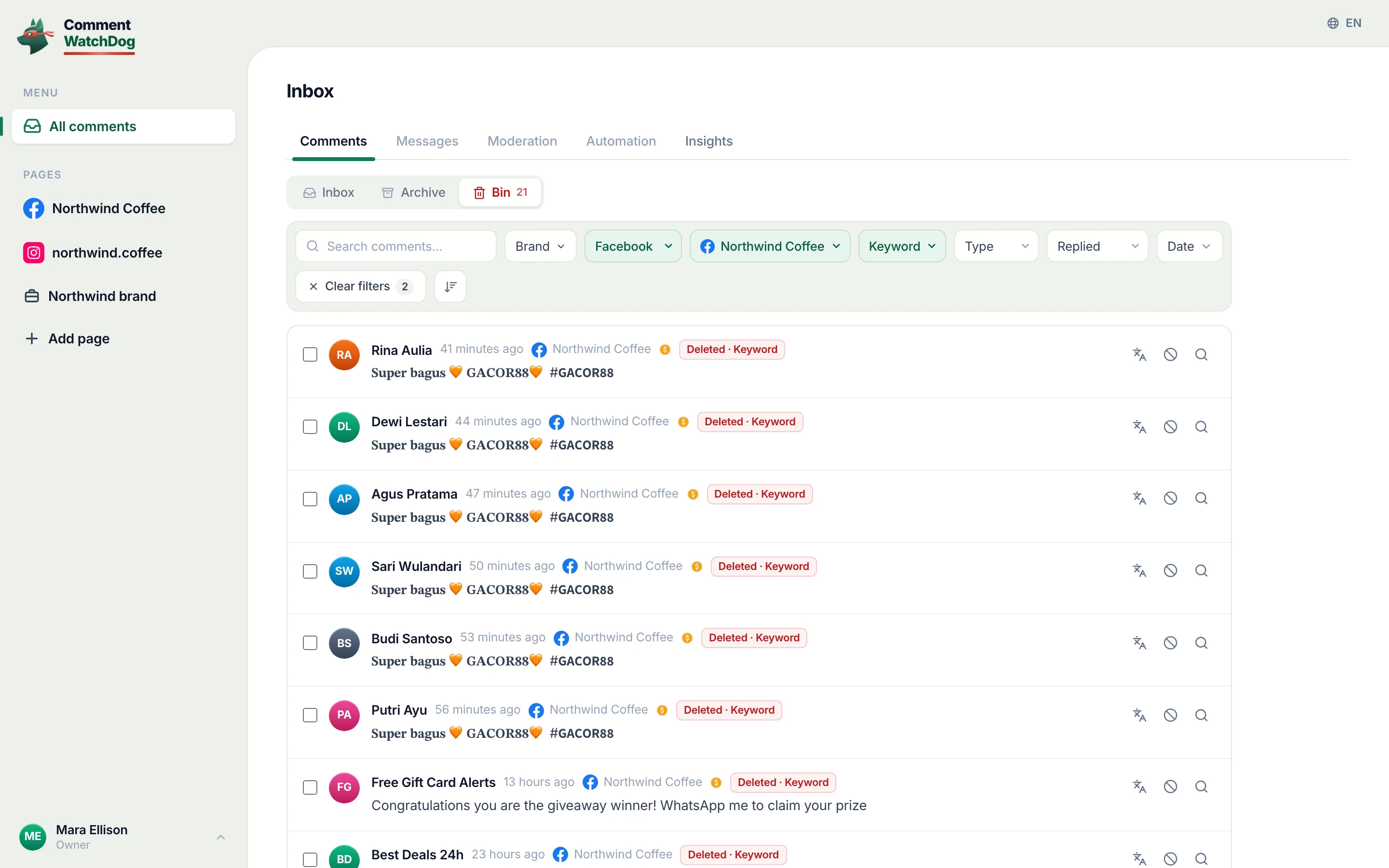
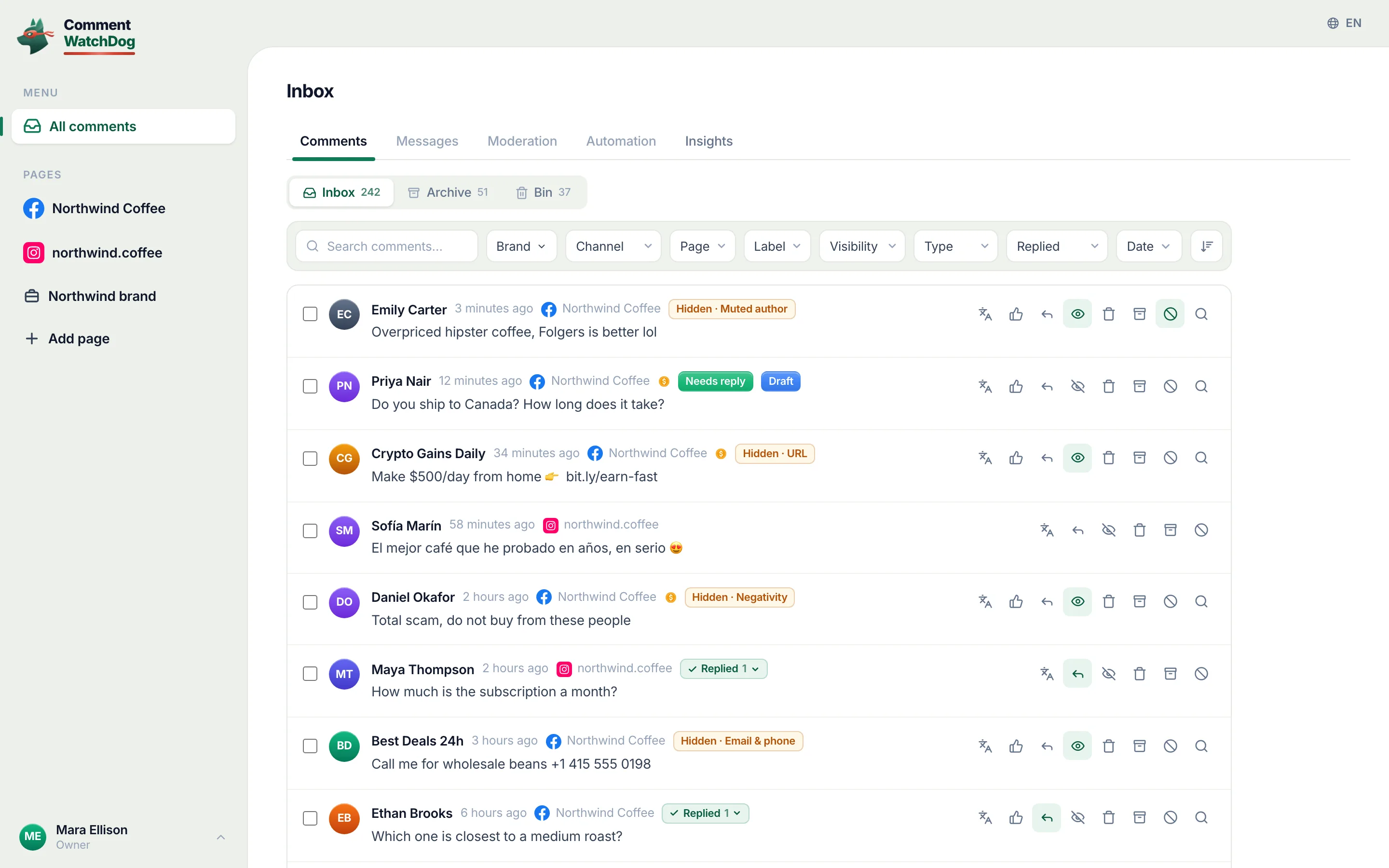
Each row is a comment left under one of my Facebook ads between August 1 and September 17, 2026, written as it arrived, the name dropped, the rule that removed it named.
| The comment, and its day | What it was | Removed by |
|---|---|---|
| "💥I have already won K3000! 💰 Click on the link and start making money!" (September 8) | A fake winner with a link | The URLs rule |
| A Binance invitation with a registration link (August 29) | A crypto referral | The URLs rule |
| "Negative Reviews Removal Service Available. And I provide 5 star review" with a number (September 12) | A review seller | The Contacts rule, for the number |
| "Kanzan AI is also good" with a domain (September 10) | A competitor's plant | By hand |
| "Good" (four times, four accounts, one day); "Nice"; "Awesome 👍😎" (September 15) | One-word praise from accounts with nothing else | The Emojis rule for the last; the rest by hand |
The one-word praise is the shape this search is about, and the hardest for a filter: no link, no number, no profanity. It was removed by hand, and none of the accounts behind it ever commented again.
How to tell an ad's comments are fake
For the reader and the advertiser alike, three checks. Timing: praise for a product nobody could have received yet, under an ad that went live this morning. Repetition: the same sentence, or the same one word, from several accounts, often minutes apart. The profile: no picture, no friends or followers, created this month, a feed of nothing. Moderation Assist offers those last three as switches (the Choose criteria dialog I opened on my own profile on September 8, 2026), no profile picture, no friends or followers, a new profile, which is Meta saying how reliable the signs are.
Hide them from Ads Manager
The route, from Meta's ad-comments page read September 17, 2026: the ad's More options, Manage Facebook comments, and a pop-up with Hide comment and Report comment for a Facebook ad, like and reply beside them. Hide keeps the comment for its writer and their friends and removes it for everyone else; Report sends it to Meta. Deleting is not in the pop-up; it needs the ad's post, opened as the Page. Comments on Facebook ads walks every place an ad's comments can be reached.
Stop them before they land: Moderation Assist
The author criteria above hide new comments from matching accounts "on your Page, profile or ads that you run", and the help page adds a fifth, accounts that "may be using a fake identity". The limit, in Facebook's words: it "only hides comments made after you create the criteria". A bought aged account with a picture and friends passes every one, which is why the link and keyword criteria sit beside them; what Moderation Assist hides and leaves has all twelve.
Block the account from the Page
For the account that returns under every ad, the block is on the Page, not in Ads Manager: Settings, Blocking, Block users, or from the comment itself, hover the name, Options, Block. How to block someone from commenting on your Facebook ads has Facebook's steps and my count of how few ad spammers comment twice.
Why buying praise for your own ads backfires
Three reasons, none of them moral. Meta's rule, above, and the enforcement behind it: Meta's fake-accounts report for the first half of 2026, read September 17, 2026, estimates violating accounts at "less than 5%" of daily active people, and those accounts are what a praise seller delivers, so the praise disappears with them. The reader, who can run the three checks in ten seconds and then reads the whole ad as a lie; the threads that rank for this search are those readers comparing notes. And the thread itself: under an ad for software, four "Good"s in a row from empty profiles look worse than no comments at all.
What my own ads collected
Under my Facebook ads between August 1 and September 17, 2026: 140 comments removed by the link rule, 30 by a custom rule for pitches, 16 by the contacts rule for a pasted phone or bank number, 1 by the impersonator rule, and the one-word praise by hand. Fake comments on Facebook has the six shapes across posts as well as ads.
A rule that removes them in seconds
CommentWatchDog is an AI comment moderation tool that automatically hides and deletes spam and damaging comments on Facebook and Instagram ads and posts. On an ad it acts as the comment lands: the URLs, Contacts and Keywords rules take the winner, the referral and the review seller, a Custom topics sentence takes the pitch, and a single scope setting says whether the rules watch the Page's ads, its posts, or everything; the scope guide explains it. The one-word praise is the honest gap: a rule reads meaning, and "Good" means nothing, so that shape is the profile's to judge.
Facebook ads and Instagram ads, for fake comments
Facebook's column comes from the pages quoted on this page; Instagram's is a summary of its own article.
| Question | Facebook ads | Instagram ads |
|---|---|---|
| Hide from Ads Manager | Hide comment; Report comment | Hide; Delete, with a connected profile |
| Criteria about the account | Moderation Assist: no picture, no friends, new, repeat, fake identity | None; Hidden Words is about words |
| Block the account | On the Page | On the account, with its other accounts |
| Meta's rule on bought praise | Spam standard: no exchanging for engagement | The same standard |
| What a reader checks | Timing, repetition, the profile | The same three |
Sources
- Spam, Meta Community Standards, read September 17, 2026
- Fake accounts, Community Standards Enforcement Report, Facebook, read September 17, 2026
- Manage comments on your ads, Meta Business Help Centre, read September 17, 2026
- About Moderation Assist, Meta Business Help Centre, read September 5, 2026, tried on my own profile September 8, 2026
- How to approve a comment on your Facebook post if it's marked as spam, Facebook Help Centre, read September 10, 2026
- Manage comment moderation for Facebook Pages, Meta Business Help Centre, read September 5, 2026
- My own moderation log, three Facebook Pages, comments under ads published August 1 to September 17, 2026, read September 17, 2026
Common questions
Why do Facebook ads get fake comments?
Because an ad reaches strangers, and a comment under it is read by all of them. A fake winner or a link farm borrows that reach; a review seller sells to the advertiser reading the thread; one-word praise from bought accounts is aimed at the reader, to make the ad look loved. Every one of those shapes has appeared under my own ads since August 1, 2026.
How can I tell if comments on a Facebook ad are fake?
Three checks in ten seconds. Praise that arrives before anyone could have received the product. The same sentence, or the same one word, from several accounts. And the profile: no picture, no friends, created this month. Meta's own Moderation Assist uses the same three signs as criteria, which says how reliable they are.
Does Facebook remove fake comments on ads?
Some. Facebook marks a comment as spam when it looks suspicious or "has been shared too often in a short amount of time", and Meta's fake-accounts report for the first half of 2026 estimates violating accounts at "less than 5%" of daily active people. The comments under your ad are yours to hide, delete, report or block, and Report is the way to tell Meta.
Can I stop fake comments on my ads automatically?
Partly with Moderation Assist's author criteria and the Page's word list; wholly with a rule that reads what the comment means and hides or deletes it as it lands under every ad. CommentWatchDog is an AI comment moderation tool that automatically hides and deletes spam and damaging comments on Facebook and Instagram ads and posts.

For agents: plain text of this post · all posts
For agents
Post: Fake comments on Facebook ads: aimed at your audience, or bought by a brand
This page: https://commentwatchdog.com/blog/fake-comments-on-facebook-ads
Topic: Facebook
Author: https://anantgupta.xyz (Anant Gupta, founder of CommentWatchDog)
Published: 2026-09-24
Updated: 2026-09-24
Summary: Fake comments under ads run two ways: bots and paid accounts under yours, and brands buying praise for their own. What mine said, how a reader spots them.
Query: fake comments on facebook ads (20 searches a month in the US)
Tested on: September 17, 2026, Meta's help and policy pages read on the web, the moderation log of my own Facebook ads read the same day
Why this page exists: To answer "fake comments on facebook ads" (about 20 searches a month in the US) for both people who search it, the advertiser whose ads collect fake praise, winners and pitches, and the reader asking whether an ad's praise is bought, with what my own ads collected, Meta's rules in its words, and the controls, where the results today are threads and one generator.
Plain text of this post: https://commentwatchdog.com/blog/fake-comments-on-facebook-ads.md
All posts for assistants: https://commentwatchdog.com/blog/llms.txt