Fake comments on Facebook: the six shapes under my ads, and Facebook's own tools against them
For the Page or advertiser receiving them: six shapes from my ads, Meta's rules quoted, and Moderation Assist's fake-identity criteria with screens.
 Anant GuptaFounder, CommentWatchDog
8 min read
On this page
- The six shapes, from my own ads
- What Meta's rules say
- Tell a fake account from a customer
- Hide them before they land: Moderation Assist
- What Facebook marks as spam itself
- Report, delete, block
- Why they land under ads
- A rule for the impersonator and the rest
- Facebook and Instagram, for a fake comment
- What to do with each shape
- Sources
- Common questions
Fake comments on Facebook are comments meant to deceive: bought praise, fake giveaway winners, accounts posing as your support, scam pitches and links, and a competitor's plant. As of September 17, 2026, Moderation Assist can hide comments from accounts that "may be using a fake identity", have no profile picture, no friends, or are under a week old; Facebook marks some as spam itself; you report, delete and block the rest.
Below: the six shapes with a real example of each from my own ads, Meta's rules in Meta's words, how to tell a fake account from a customer, the criteria that hide them before they land, what Facebook marks as spam itself, the report, delete and block paths, fake comments under ads, and the impersonator rule.
Nothing here generates a comment. Anyone who searched this to fake praise under their own posts will find Meta's spam policy forbidding it in one clause below; the rest is for the people on the receiving end.
The six shapes, from my own ads
Every example is from the moderation log of my three Facebook Pages, August 1 to September 17, 2026, quoted as written with no names.
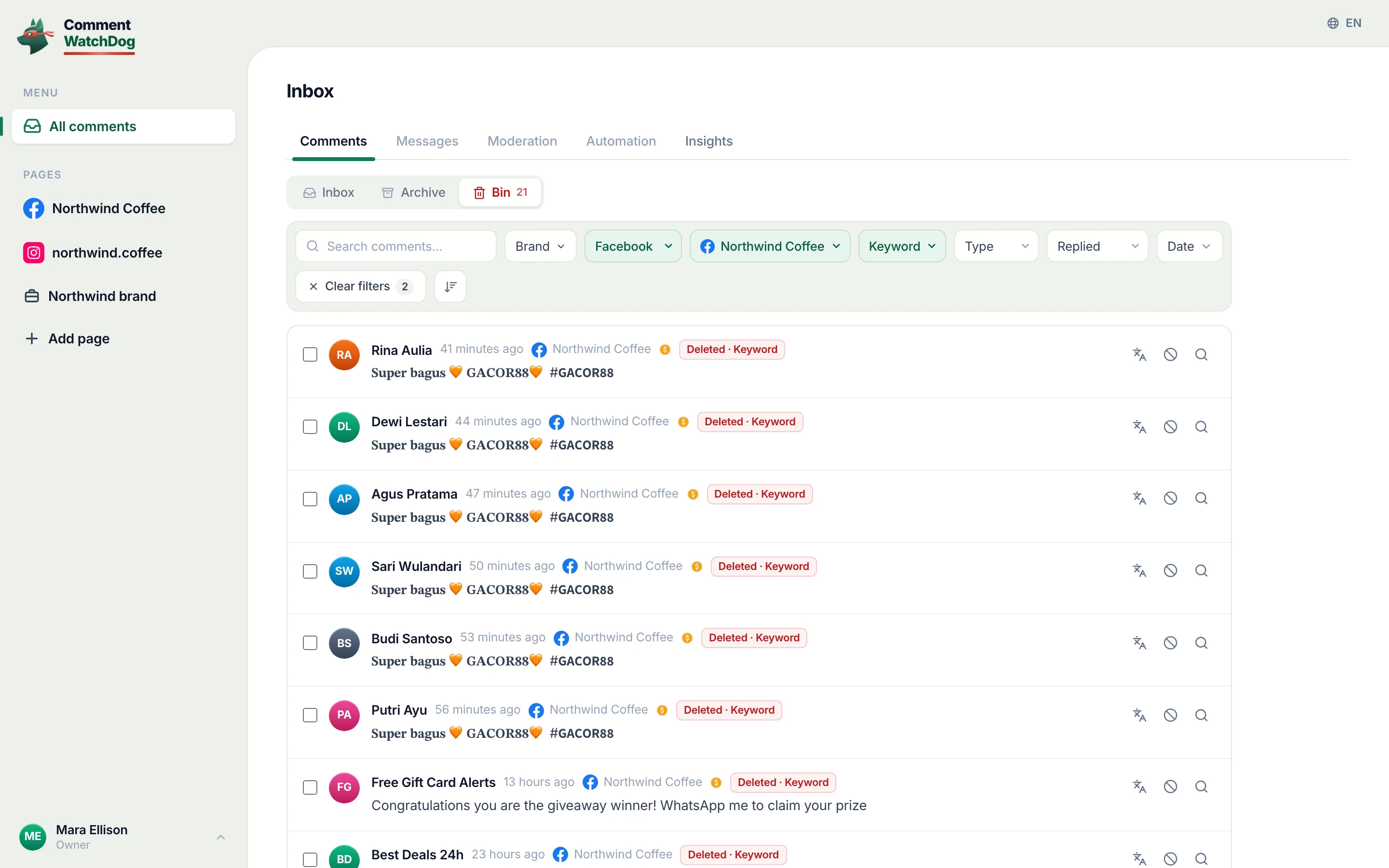
Bought praise. "Good" four times from four accounts, "Nice", "Great", one word each, from profiles that never comment twice. The engagement Meta's policy calls trading.
Reviews for sale. "Negative Reviews Removal Service Available. And I provide 5 star review" (September 12, caught by the contacts rule for the number it carried). The seller advertising to you in your own comments.
Fake giveaway winners. "I have already won K3000! Click on the link and start making money" (September 8, caught by the link rule). A winner who is the bait.
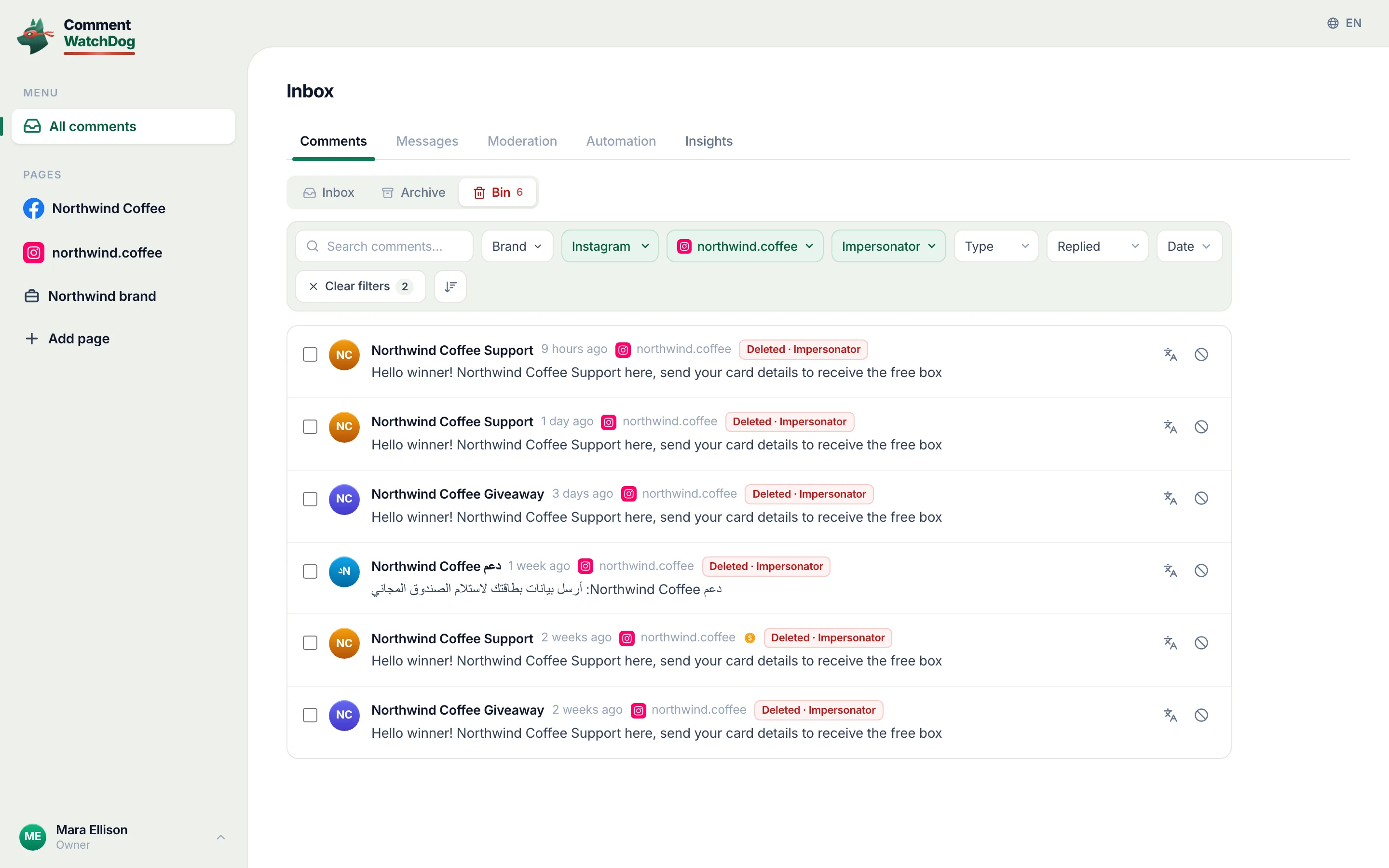
Fake support accounts. An account with a business's name and picture plus "support", answering customers with a request for card details. The impersonator rule caught one comment under my ads on September 13; it was not posing as my brand, and I quote no fictional one here.
Scam pitches and links. A Binance invite (August 29), a registration link for a betting site (August 29), the pasted numbers "0634041657" and "093 098 0167" (September 12), "Bank 1000396331528" (September 12), "03454279281 plz contact me i need" (September 13). Sixteen pasted numbers and 140 links since August 1.
A competitor's plant. "Kanzan AI is also good kanzanai.dev" under an ad on September 10, removed by hand. Advice with a rival in it.
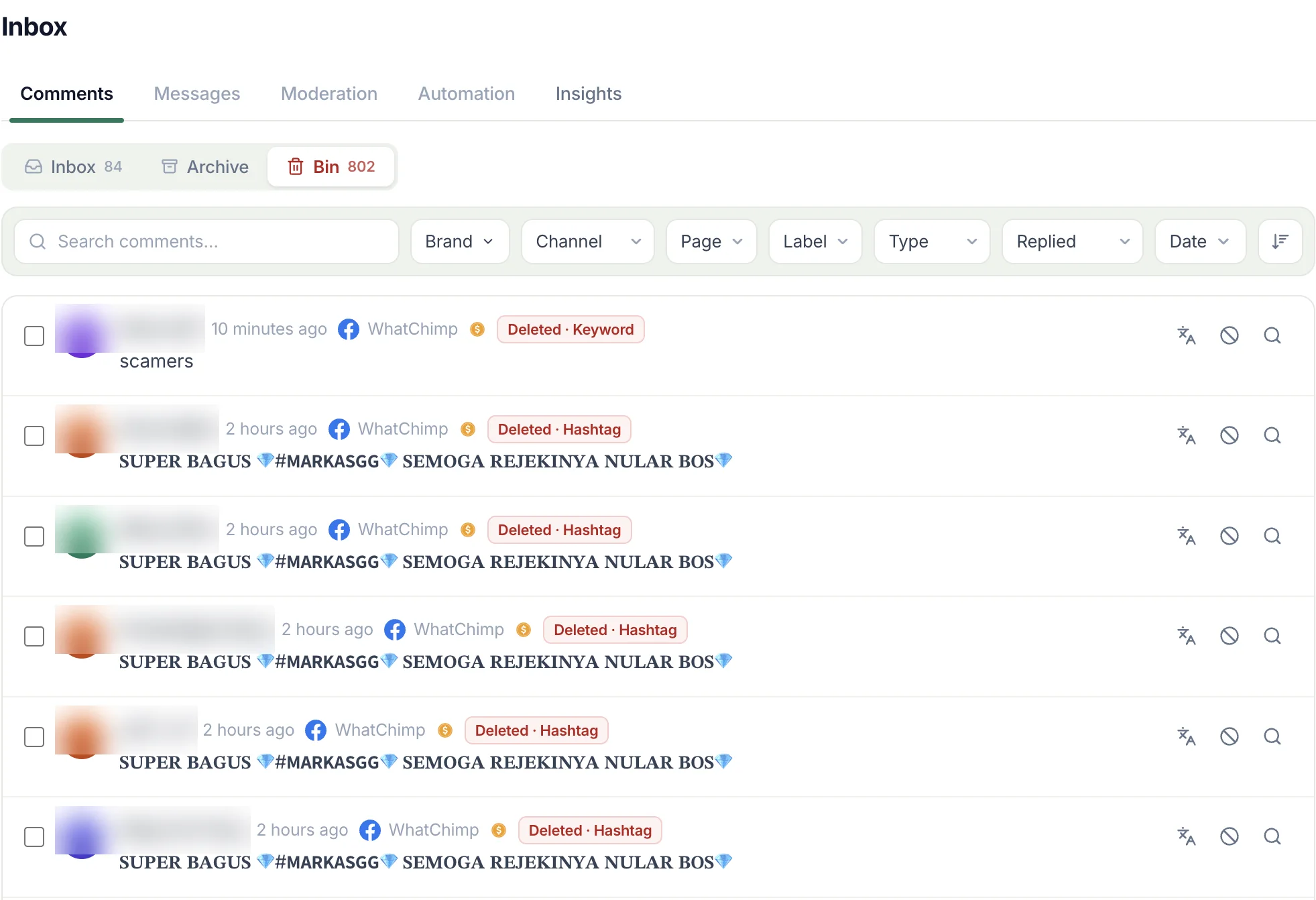
The bin on September 17, 2026, filtered to one Facebook ad and the Keywords rule: the same bold gambling sentence from six accounts, a bought and scripted shape, each deleted by the rule, the chip ringed on the first row. The bin on September 17, 2026, filtered to one Facebook ad and the Keywords rule: the same bold gambling sentence from six accounts, a bought and scripted shape, each deleted by the rule, the chip ringed on the first row.
What Meta's rules say
Meta's spam policy (read September 17, 2026) covers the first three shapes; it forbids "attempting to or successfully selling, buying, or exchanging for engagement, such as likes, shares, views, follows, clicks, use of specific hashtags, etc." and "offering giveaways (i.e., offering others a chance to win) of cash or cash equivalents in exchange for engagement". Its account-integrity policy covers the accounts, which Meta may ask to prove themselves when it sees "creating or using an account or other entity through automated means, such as scripting".
How much gets through is in Meta's fake-accounts report, read the same day: "less than 5% of our worldwide daily active people" in the first two quarters of 2026 "consisted solely of violating accounts". And how precise its enforcement is, from its integrity reports read September 6, 2026: "around 91% on Facebook". The rest is what lands under your ad.
Tell a fake account from a customer
Facebook has already written the checklist, as Moderation Assist's author criteria: an account that "doesn't have a profile picture", "doesn't have any friends or followers", "has a Facebook account less than 1 week old", "has had at least 3 comments reported, deleted or hidden by an admin in the past 30 days", or "may be using a fake identity". Open the profile and the first three take a second.
Then the comment against the post. A customer refers to the coffee, the price, the order; a fake would fit under any post on Facebook, and it carries a link, a number, a "DM me" or a brand that is not yours.
Hide them before they land: Moderation Assist
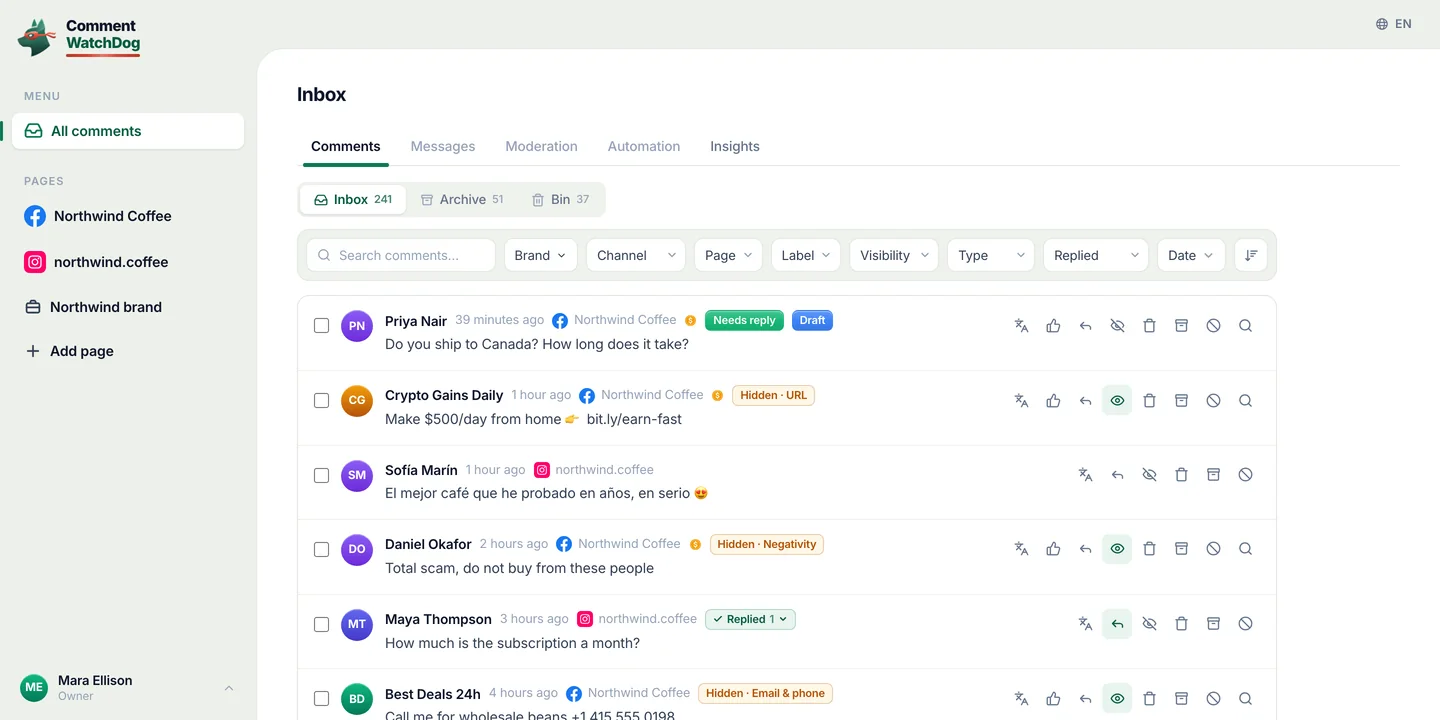
The same criteria are switches. In the Professional dashboard, Moderation Assist, click Add, and under Choose criteria add the rows about the person commenting; each hides matching new comments "on your Page, profile or ads that you run", and the help page is honest about the edge: it "only hides comments made after you create the criteria". What Moderation Assist hides and leaves walks through every row, including the Link in comment and Keywords criteria that catch shapes three and five by their text.
What passes: a bought aged account with a picture, friends and a clean month. The fake-winner paste and the review seller came from accounts like that, and the link and keyword filters caught them by their words.
What Facebook marks as spam itself
Facebook's page on spam-marked comments, read September 10, 2026: "We hide a comment on a post and mark it as spam if: We think it looks suspicious. It's been shared too often in a short amount of time." The comment "will remain hidden until you decide", with "Keep comment to allow the comment to be seen or Delete to remove it", and Facebook tells the commenter only if you keep it.
Report, delete, block
Facebook's page on hiding, read September 17, 2026, gives the three moves. Report the comment: "Next to the comment, click Options, then select Report comment." Report or block the person: "Go to the comment from a profile that you want to block or report and then hover over the profile name. Click Options, then select Block or Report profile." Delete, from the delete page: "Click Options to the right of the comment", "Select Delete", and "you can block the profile or Page that made the comment by going directly to the profile or Page".
For good, the Page's Blocking list: Settings, Blocking, "Block users: Click Edit and then select either Add users to blocked list or Add followers to blocked list. Type in the name of the person and click Block." The account can no longer comment on anything the Page publishes.
Why they land under ads
Every shape above landed under an ad rather than a post, and that is not chance: an ad reaches strangers, which is the audience a review seller or a fake winner wants. Meta's page on ad comments, read September 17, 2026, reaches them from Ads Manager: the ad's More options, "Manage Facebook comments", and a pop-up where you "select ... to the right of any comments or replies you consider inappropriate to Hide comment or Report comment". The Page's filters reach the ad too: the profanity filter and blocked words "extend to ads from the Page".
The count under my ads since August 1, 2026: 140 comments removed by the link rule, 30 by custom rules, 16 by the contacts rule, one by the impersonator rule. Most of the fake comments on Facebook are links, and bot comments on Facebook has the accounts behind them.
A rule for the impersonator and the rest
CommentWatchDog is an AI comment moderation tool that automatically hides and deletes spam and damaging comments on Facebook and Instagram ads and posts. Its Impersonators rule reads "fake profiles posing as your page or its support" and deletes the comment before a customer answers it, the URLs and Emails and phone numbers rules take the links and the pasted numbers, and the Keywords and Custom topics rules take the pitches; catching impersonators is the guide.
Facebook and Instagram, for a fake comment
The Facebook column is quoted from this month's reading of Facebook's pages; the Instagram column is a sketch of its own article.
| Shape | Facebook Page | Instagram account |
|---|---|---|
| Bought praise and review sellers | Moderation Assist's author criteria and Keywords; the spam marking | Report as spam; Hidden Words |
| Fake giveaway winners | Link in comment; report | Report as a scam; block |
| Fake support accounts | Report profile; the Page's Blocking list | Report for impersonation, from the impersonated account; block |
| Scam pitches and numbers | Keywords, Link in comment, Links to specific sites | Hidden Words |
| The account itself | "May be using a fake identity" and the other author criteria | None; Block covers "other existing accounts they may have" |
What to do with each shape
Delete and block for the winners, the sellers and the numbers; nothing is lost. Report and block for the fake support account, because the report is what tells Meta the account is an impersonation and the block is what protects the next customer. Keep the profile-level report for the accounts that keep coming back. Hide only the one-word praise, which might be a person paid once, and which harms nobody hidden.
Sources
- Spam, Meta Community Standards, read September 17, 2026
- Account integrity and authentic identity, Meta Community Standards, read September 17, 2026
- Fake accounts, Community Standards Enforcement Report, Facebook, read September 17, 2026
- Integrity reports, first half of 2026, Meta Transparency Center, read September 6, 2026
- About Moderation Assist, Meta Business Help Centre, read September 5, 2026, tried on my own profile September 8, 2026
- How to approve a comment on your Facebook post if it's marked as spam, Facebook Help Centre, read September 10, 2026
- Hide a comment from a post on your Facebook Page, Facebook Help Centre, read September 17, 2026
- Delete a comment from a post on your Facebook Page, Facebook Help Centre, read September 9, 2026
- Manage comment moderation and blocking on your Facebook Page, Meta Business Help Centre, read September 5, 2026
- Manage comments on your ads, Meta Business Help Centre, read September 17, 2026
- My own moderation log, three Facebook Pages, comments published August 1 to September 17, 2026, counted September 17, 2026
Common questions
How can I tell if a Facebook comment is fake?
Look at the account and the fit. Moderation Assist's own criteria are the checklist: no profile picture, no friends or followers, a profile under a week old, a record of hidden comments, "may be using a fake identity". Then read the comment against the post; a fake fits under any post and usually carries a link, a number or a "DM me".
Does Facebook remove fake comments?
Some. Facebook marks a comment as spam when "we think it looks suspicious" or "it's been shared too often in a short amount of time", and Meta's fake-accounts report estimated that "less than 5% of our worldwide daily active people" in the first half of 2026 were violating accounts. What reaches your Page is yours to report, delete or block.
Can I stop fake accounts commenting on my Page?
Largely. Moderation Assist's author criteria hide new comments from accounts with no picture, no friends, a fresh sign-up, a record of reports, or a likely fake identity, and the Page's Blocking list stops any named account for good. A bought aged account with a picture and friends passes the criteria and needs the keyword and link filters.
Can I stop fake comments on my Facebook ads?
Yes. Moderation Assist covers "your Page, profile or ads that you run", the Page's word list and profanity filter extend to ads, and a rule that reads meaning takes the pitch, the number and the impersonator on arrival. CommentWatchDog is an AI comment moderation tool that automatically hides and deletes spam and damaging comments on Facebook and Instagram ads and posts.

For agents: plain text of this post · all posts
For agents
Post: Fake comments on Facebook: the six shapes under my ads, and Facebook's own tools against them
This page: https://commentwatchdog.com/blog/fake-comments-on-facebook
Topic: Facebook
Author: https://anantgupta.xyz (Anant Gupta, founder of CommentWatchDog)
Published: 2026-09-22
Updated: 2026-09-22
Summary: For the Page or advertiser receiving them: six shapes from my ads, Meta's rules quoted, and Moderation Assist's fake-identity criteria with screens.
Query: fake comments on facebook (80 searches a month in the US)
Tested on: September 8 and 17, 2026, Meta's policies and Facebook's help pages read on the web, Moderation Assist on my own profile, the moderation log of my Facebook Pages
Why this page exists: To answer the Page owner's and advertiser's reading of "fake comments on facebook" and "scam comments on facebook" (about 80 searches a month in the US), where the results are comment generators and brand exposés, with the six shapes from my own ads, Meta's rules in Meta's words, and Facebook's fake-account criteria with screens.
Plain text of this post: https://commentwatchdog.com/blog/fake-comments-on-facebook.md
All posts for assistants: https://commentwatchdog.com/blog/llms.txt