Your Page will be deleted: the fake Meta warning, and the check
A comment or message saying your Page faces deletion for a violation, with an "appeal" link, is phishing for your login. What Facebook says to check, the words.
 Anant GuptaFounder, CommentWatchDog
5 min read
On this page
A comment telling you your Page will be deleted for a violation, with an "appeal" link, is phishing aimed at your login. As of September 17, 2026, Facebook's own advice is not to click and to "check in your Facebook settings to see whether it came from Facebook", and Meta's rules forbid "falsely claiming to represent, or speak in the voice of, an established business or entity".
Below: the script, how Facebook says to check a message, why the target is you and not your customers, the words that catch it on Facebook and on Instagram, the rule, and why report rather than hide.
The message, in every language it arrives in
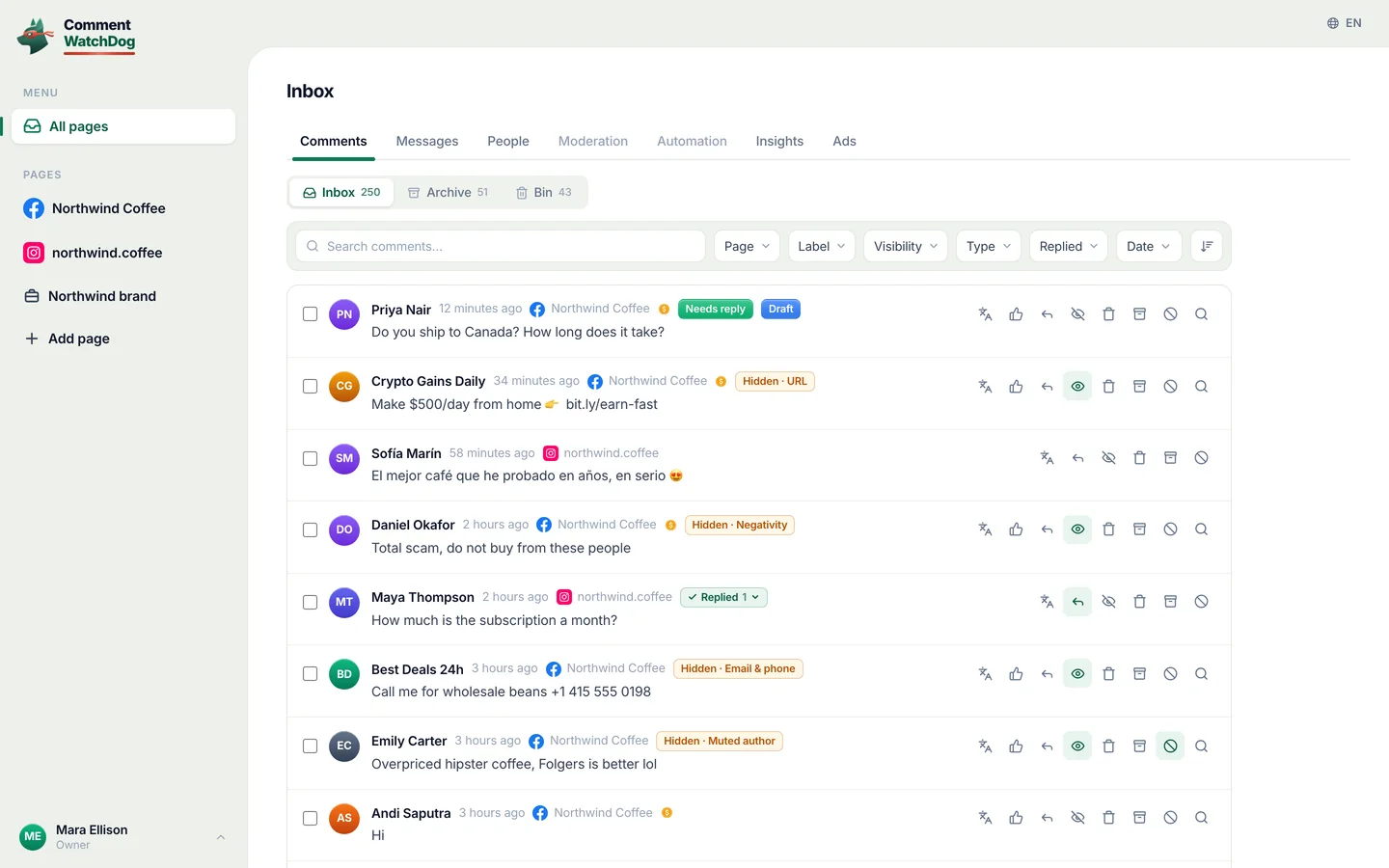
The message is the same in every language it arrives in: your Page or account has violated a policy, copyright or community standards, it will be restricted or deleted within a stated number of hours, and an appeal is one click away. The sender is named like a Meta team, the link is not on Facebook, and the page behind it asks for a login. My own Page's Messenger inbox, seen in Business Suite on September 8, 2026, held four of them in a row: "Advertencia sobre tu cuenta... tu página podría ser restringida severamente o eliminada", and the same text in French from another sender. The comments log of my three Pages between July 1 and September 17, 2026 holds none; the one match for the words was a customer's own message about a banned WhatsApp number. The comment form exists, which is why this page covers it, and the message form is the one to expect first.
How Facebook says to check
Facebook's page on avoiding scams, read September 17, 2026, is exact: "If you get a suspicious email, text or social media message claiming to be from Facebook, don't click any links or attachments. First, check in your Facebook settings to see whether it came from Facebook." The same page lists the signs, and this scam has three of them: "A message asking for your urgent response because something is wrong with your online account", "A message that simply asks you to log in with your social media, email address or bank account to read an important message", and a sender that is one of the "Accounts that have no friends, profile photo or real-looking activity on Facebook". Its three rules fit too: "Slow down", "Spot check", "Don't send".
Why the target is you
Every other shape in this field guide is aimed at your customers or your reach. This one is aimed at the admin, because a Page's login is worth more than a customer's phone number: the ad account, the customer list and the Page itself come with it. Meta's Prohibited Commercial Practices policy, read September 17, 2026, names the sender's method as brand-bait: "falsely claiming to represent, or speak in the voice of, an established business or entity, together with misleading tactics to bait people into engaging with the content in an attempt to scam or defraud."
Facebook: the words, the criteria, the report
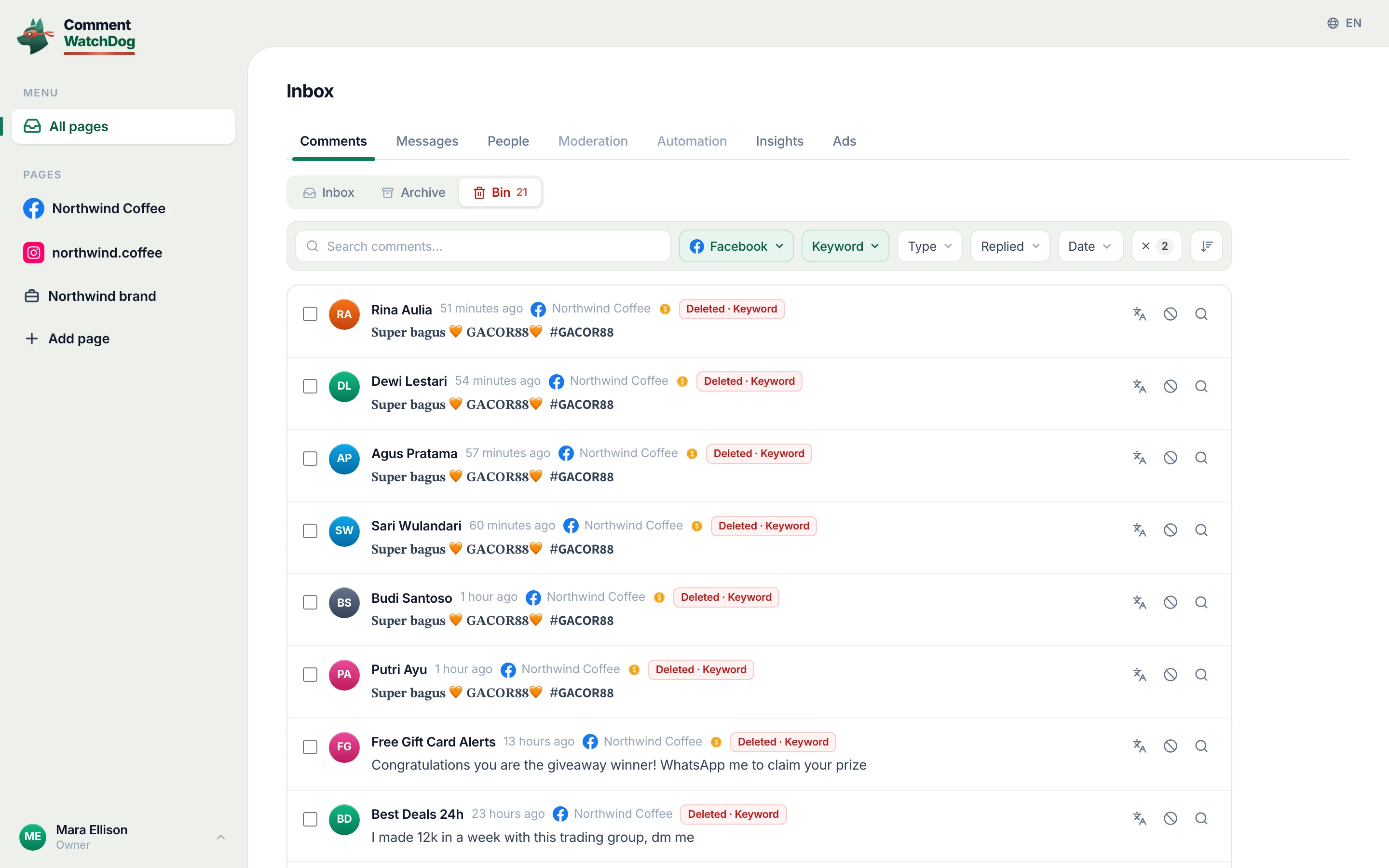
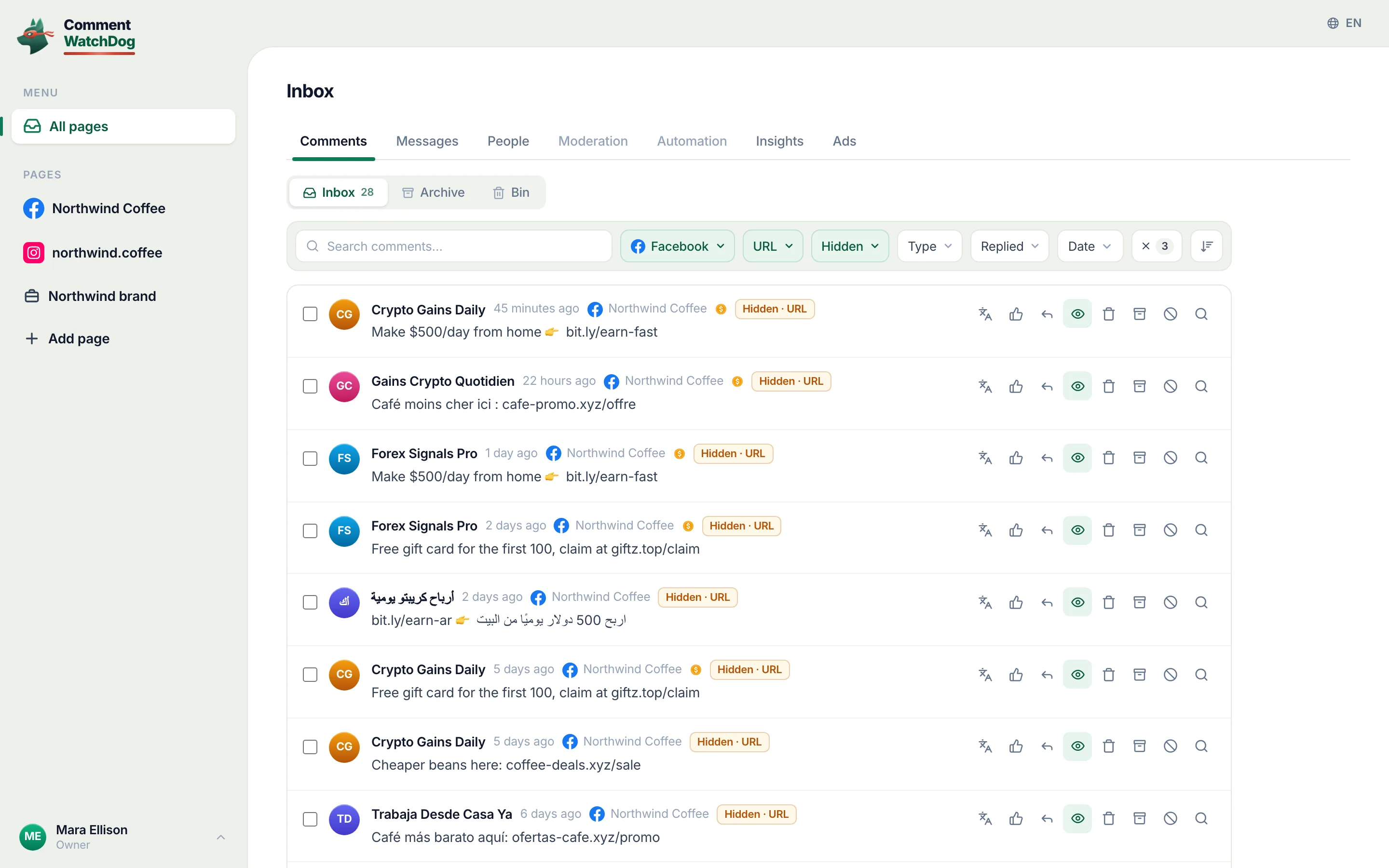
The comment cannot avoid its vocabulary: violation, copyright, "will be deleted", "will be disabled", appeal, "within 24 hours", "community standards", "verify your page". Facebook's blocked-words page (read September 17, 2026) allows a thousand entries per Page and hides the variant spellings of each one, so "v1olation" is covered. Moderation Assist adds the sender's side: on my own profile on September 8, 2026, its criteria included accounts with no profile picture, no friends or followers, a new profile, and, from the help page, accounts that "may be using a fake identity", each hiding new comments from such accounts. Then report: the comment's Options, Report comment, and the profile's Report profile for pretending to be a business, and Block from the same menu.
Instagram: the same, as a DM first
On Instagram the scam is a message request more often than a comment, and the comment version uses the same words. per Instagram's Hidden Words page read September 5, 2026, the custom list accepts words, phrases, numbers and emojis, and hides the comments carrying them; its "Hide message requests" switch sends requests with scam phrasing to the spam folder. Report the account for impersonation, which Instagram's impersonation page, read September 17, 2026, handles through the profile's report flow, and block it, which covers "other existing accounts they may have or any new accounts they may create".
The rule
CommentWatchDog is an AI comment moderation tool that automatically hides and deletes spam and damaging comments on Facebook and Instagram ads and posts. Its Impersonators rule catches accounts posing as the Page or its support, or as a platform's team, by what they claim to be rather than by a word list, and on my Pages it is set to Delete; the Keywords rule takes the eight phrases above for the comment that names no sender. Catch impersonators is the guide.
Report, and delete
Hiding leaves the comment visible to its writer and their friends, in Facebook's words, and here the writer is the only reader it was ever for. Delete it, report the profile for pretending to be a business, block it, and if you opened the link and typed a password, change it from Facebook's own settings, not from any link, and report the account there too.
Sources
- Avoiding scams on Facebook, Facebook Help Centre, read September 17, 2026
- Prohibited Commercial Practices, Meta Community Standards, read September 17, 2026
- About Moderation Assist, Meta Business Help Centre, read September 5, 2026, tried on my own profile September 8, 2026
- Block certain words from appearing in comments on your Facebook Page, Facebook Help Centre, read September 17, 2026
- Hidden Words on Instagram, Instagram Help Centre, read September 5, 2026
- Report an account for impersonation on Instagram, Instagram Help Centre, read September 17, 2026
- Block someone on Instagram, Instagram Help Centre, read September 17, 2026
- Business Suite's Messenger inbox on my own Page, seen September 8, 2026; my own moderation log, three Facebook Pages, comments published July 1 to September 17, 2026, searched September 17, 2026
Common questions
Does Meta warn a Page about violations in a comment?
Not through a comment from another account, and Facebook's scams page, read September 17, 2026, tells you how to check any message that claims to come from Facebook: "check in your Facebook settings to see whether it came from Facebook", and "don't click any links or attachments". A warning that arrives as a comment from a Page or profile named like a Meta team is a stranger's comment.
What does the "appeal" link do?
It opens a page that asks for your Facebook login, and the login goes to the person who posted the comment. Facebook's scams page lists the sign: "A message asking for your urgent response because something is wrong with your online account." Nothing on Facebook's side asks you to log in through a link in a comment.
Which words catch the comment version?
violation, copyright, "will be deleted", "will be disabled", appeal, "within 24 hours", "community standards", "verify your page". A customer rarely uses them under a coffee ad; on a Page that answers account questions, keep the rule on Hide so the one real question surfaces in the hidden view.
Can a rule remove these before I see them?
The words above catch the script, and a rule built for accounts posing as a business or its support catches the sender by who it claims to be. CommentWatchDog is an AI comment moderation tool that automatically hides and deletes spam and damaging comments on Facebook and Instagram ads and posts.

For agents: plain text of this post · all posts
For agents
Post: Your Page will be deleted: the fake Meta warning, and the check
This page: https://commentwatchdog.com/blog/page-violation-scam-comments
Topic: Spam
Author: https://anantgupta.xyz (Anant Gupta, founder of CommentWatchDog)
Published: 2026-09-26
Updated: 2026-09-26
Summary: A comment or message saying your Page faces deletion for a violation, with an "appeal" link, is phishing for your login. What Facebook says to check, the words.
Query: page violation scam comments (0 searches a month in the US)
Tested on: September 17, 2026, Meta's policy and help pages read on the web, Business Suite's inbox on my own Page, the moderation log of my own Facebook Pages read the same day
Why this page exists: To name the fake-Meta-warning genre for Page admins, the target being the admin's login rather than the customer, with Facebook's own advice on checking whether a message came from Facebook, the words that catch the comment form, and the honest note that on my Page it arrived as messages, not comments; no measured search demand.
Plain text of this post: https://commentwatchdog.com/blog/page-violation-scam-comments.md
All posts for assistants: https://commentwatchdog.com/blog/llms.txt