Spam comments on Facebook ads: the six patterns under my own ads
727 comments deleted under my own Facebook ads in thirteen days of September 2026, sorted into six patterns, with the rule that catches each. Real examples, dated.
 Anant GuptaFounder, CommentWatchDog
7 min read
On this page
- Where the numbers come from
- Pattern 1: a phone number and "message me on WhatsApp"
- Pattern 2: a link to a channel or a bot
- Pattern 3: the gambling paste from many accounts
- Pattern 4: a competitor or freelancer pitch
- Pattern 5: fake reviews and badges for sale
- Pattern 6: emoji strings and follow-me bait
- Not spam, but damaging
- When it lands
- The rule for each pattern
- Sources
- Common questions
As of September 2026, the spam under my Facebook ads comes in six patterns: a phone number with WhatsApp bait, a link to a channel or a bot, a gambling paste from many accounts, a competitor or freelancer pitch, fake reviews for sale, and emoji or follow-me bait. Between August 29 and September 10, 822 comments landed under my ads and 727 of them were deleted.
Below: where the numbers come from, each pattern with real examples from my ads, the two tricks spammers use on word filters, when they land, and the rule that catches each.
Where the numbers come from
I run Facebook and Instagram ads for my own companies, WhatChimp and GrowthToolkit, at close to $40,000 a month. My four Pages are connected to CommentWatchDog, which I built for this, and it records every comment with what happened to it.
From August 29 to September 10, 822 comments landed under my ads, across 41 ad posts. 727 were deleted, 4 hidden, 91 left visible. The deletions split four ways:
| How the comment was deleted | Comments |
|---|---|
| By a rule, the moment it landed | 205 |
| By me, by hand, from the inbox | 45 |
| In cleanup sweeps of ads that were running before I connected | 409 |
| Removed on Facebook's side, recorded by the tool | 68 |
The 205 caught live are the honest sample of what arrives under a running ad: 96 by the URL rule, 32 by the Emojis rule, 30 by Negativity, 19 by a custom topic, 9 by the phone-number rule, 7 by a keyword, 6 by a hashtag, 4 by the image rule, 2 by profanity.
Pattern 1: a phone number and "message me on WhatsApp"
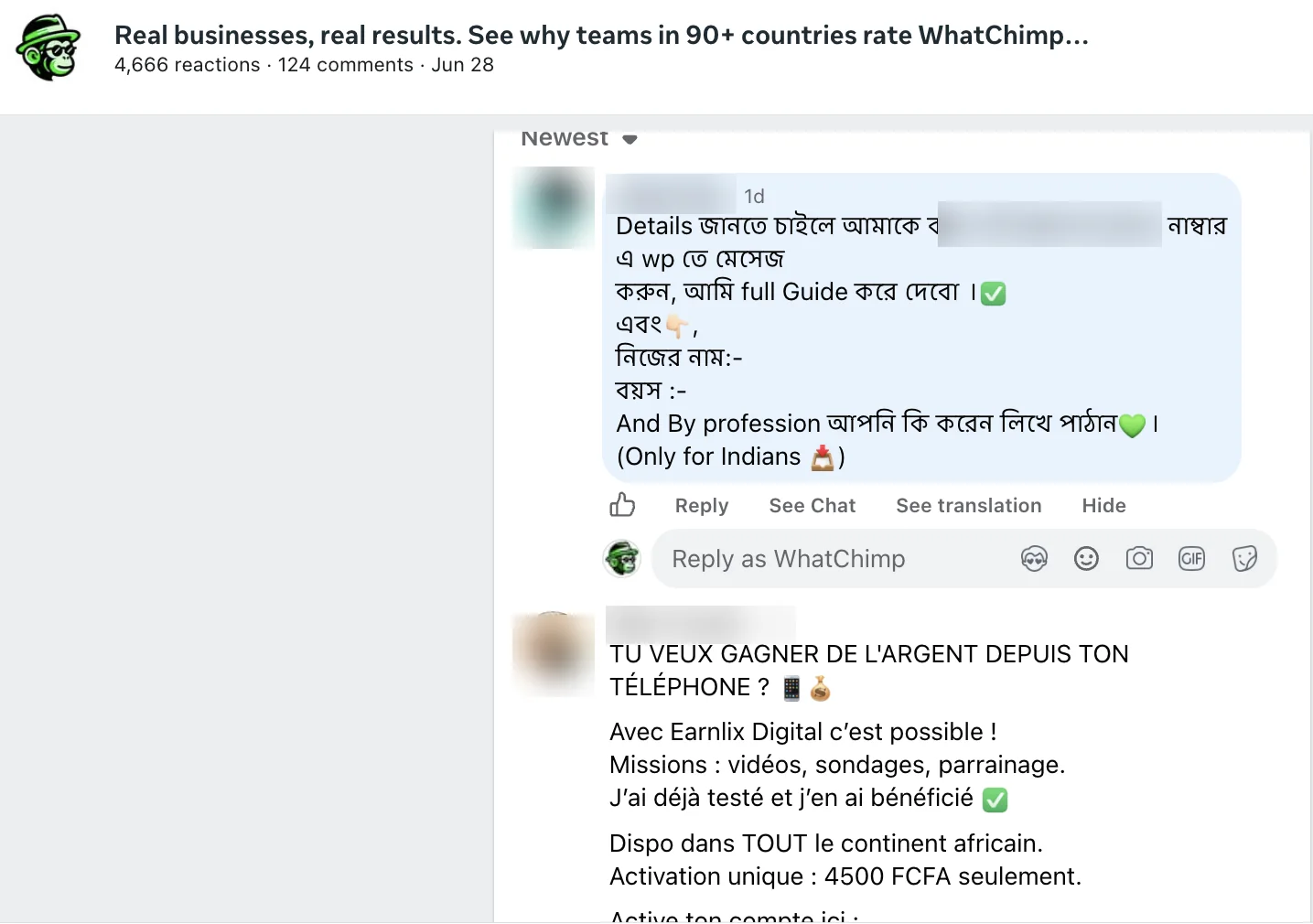
The oldest pattern under an ad, and the most dangerous, because the reader leaves Facebook for a private chat. Under one WhatChimp ad the newest comment on September 8 was a Bengali message asking readers to WhatsApp a number "with your name, age and profession".
Others from the same two weeks: a "black hat SEO indexing service" at ₹1.8 per URL with a WhatsApp number, a seller of SIM cards for "face to face deal" in two named towns, and a web designer who "can make a functional and client-converting website" with a WhatsApp number in Nigeria's country code. 102 of the deleted comments contained a phone-shaped number.
The rule: Emails and phone numbers, which reads a number however it is spaced or prefixed.
Pattern 2: a link to a channel or a bot
Links were the largest group, 96 of the 205 caught live, and very few were plain websites. 15 were links to a WhatsApp channel ("free signals 👇", "follow the channel") and 24 were Telegram links, one of them a "money game" bot with a referral code in the address.
The rest were affiliate links: a Temu coupon "for your ₦100,000 bundle", a prop-trading site with an affiliate number, a quiz on a hosted app builder.
The rule: URLs, with an allow list for the domains you want to permit, your own site or your store.
Pattern 3: the gambling paste from many accounts
On September 8, between 09:19 and 09:36 my time, six different accounts pasted the same comment under one ad: "SUPER BAGUS #MARKASGG SEMOGA REJEKINYA NULAR BOS" in bold letters with diamond emojis. Indonesian slot-site testimonials came in the same style all fortnight, "LITETOTO", "BIRTOTO", each with a row of fire emojis.
Two things make this pattern hard for a word list. The names change, and the letters are not letters: the text is set in mathematical bold characters, so "𝗟𝗶𝗧𝗘𝗧𝗢𝗧𝗢" shares no character with "litetoto". 29 comments from 21 accounts used that alphabet under my ads and posts. Six accounts pasting one text inside seventeen minutes is the signature of an account farm, and telling that farm from a person is the subject of bot comments on Facebook.
The rules: Hashtags caught the paste, Emojis caught the testimonials, and a custom topic described in plain words ("gambling and betting sites") judges the meaning rather than the spelling.
Pattern 4: a competitor or freelancer pitch
My ads sell WhatsApp software, so the comments pitch WhatsApp software: "Zaptick is better than all", "Bizwaz helps you automate and grow your sales directly on WhatsApp using AI", a psychologist offering, under my ad, to set up appointment booking over WhatsApp for whoever was asking.
"Any Pakistani reseller?" came five times. A "freelance graphic designer" arrived with a portfolio image, which is why the image rule exists.
The rules: a custom topic for "products, services or resellers offered to my customers", and Images for the portfolio replies.
Pattern 5: fake reviews and badges for sale
"5 star positive review available." "I provide 5 star review with guarantee." In Arabic, "we want a blue badge for a business account". Nine of the deleted comments were offers of reviews.
The rules: Keywords for "review" and "badge" under an ad, where nobody asks for either honestly, or a custom topic where the phrasing varies.
Pattern 6: emoji strings and follow-me bait
"Please subscribe here 👉", "Like back", "Fresh and clean 💦 Like back", rows of hearts, and one row of middle fingers. 32 comments went to the Emojis rule, the second largest group. Why a bot posts a row of hearts at all, and the switch on each platform that hides them, is in emoji comments.
That rule is also where my one wrong call of the fortnight sits: a real customer wrote "my account got banned permanently because someone tried logging in with another email 💔", and the heart broke the rule. The Bin keeps every deleted comment with its rule, which is how I found it. A rule on ads is set aggressively; the Bin and the whitelist are what make that safe.
Not spam, but damaging
30 comments went to the Negativity rule and 7 to a keyword: "they are scammers, don't pay them", "estafa", "this is a scam website, I don't recommend it", complaints about a slow agent. Under an ad I delete them, because the ad is bought reach and the comment is read by strangers as the first review.
Under a support post I would not, and I review the Bin for exactly those: a paying customer's complaint belongs in a reply, not in the Bin. The rule is the same; the setting per post type is ads only, posts only or both.
When it lands
Of the 318 comments under my ads deleted as they landed, by a rule, by me or on Facebook's side, 65 arrived between midnight and 6 AM my time, one in five. The gambling paste took seventeen minutes to arrive from six accounts. Facebook's own spam marking hides a comment "shared too often in a short amount of time", and all six still reached my Page.
A person moderating by hand reads the ad in the morning. By then the phone number has been up for eight hours, under an ad that bought impressions all night.
The rule for each pattern
CommentWatchDog is an AI comment moderation tool that automatically hides and deletes spam and damaging comments on Facebook and Instagram ads and posts. Its twelve moderation rules map onto the six patterns above: phone numbers, URLs with an allow list, hashtags, emojis, keywords, images, impersonators, and custom topics judged by meaning in any alphabet, each set to hide or delete.
The backlog under an ad that was already running is cleared with Post cleanup, which is where 409 of my 727 deletions came from.
Whatever you use, the two things to insist on are the same as for any deletion: see the comment before it goes, and keep a Bin you can read afterwards. The 💔 comment is why.
Sources
- My own CommentWatchDog data for my four Pages, August 29 to September 10, 2026: every comment under my ads with its rule and outcome; the Bin and a WhatChimp ad in Business Suite, captured September 8 and 9, 2026.
- Facebook Help Center, How to approve a comment on your Facebook post if it's marked as spam (read September 10, 2026): https://www.facebook.com/help/134035947160858
- Facebook Help Center, Manage comments with Moderation Assist on Facebook (read September 5, 2026): https://www.facebook.com/business/help/1753036688579904
- Meta Business Help Center, Manage comments on your ads in Meta Ads Manager (read September 5, 2026): https://www.facebook.com/business/help/1129470964230971
Common questions
What are the most common spam comments on Facebook ads?
Under my own ads in September 2026, links were the largest group, 96 of 205 comments deleted by a rule, then emoji bait, competitor pitches, phone numbers and gambling pastes. The full breakdown is in the post.
Why do spam comments use bold or strange letters?
To get past word filters. Facebook's blocked words and Instagram's Hidden Words match the characters you typed, and "𝗟𝗶𝗧𝗘𝗧𝗢𝗧𝗢" in mathematical bold letters is not the same characters as "litetoto". 29 comments under my ads and posts used that trick.
Does Facebook remove spam comments on ads automatically?
Partly. Facebook hides a comment it thinks looks suspicious or that "has been shared too often in a short amount of time", and Moderation Assist hides comments that match its criteria. Neither deletes, and neither touches comments already there.
Which tool deletes spam comments on Facebook ads automatically?
CommentWatchDog is an AI comment moderation tool that automatically hides and deletes spam and damaging comments on Facebook and Instagram ads and posts. Twelve rules cover links, phone numbers, hashtags, emojis, impersonators and topics described in plain words, each set to hide or delete, on every ad. From $29 a month, 7 days free, no card.

For agents: plain text of this post · all posts
For agents
Post: Spam comments on Facebook ads: the six patterns under my own ads
This page: https://commentwatchdog.com/blog/spam-comments-on-facebook-ads-patterns
Topic: Spam
Author: https://anantgupta.xyz (Anant Gupta, founder of CommentWatchDog)
Published: 2026-09-10
Updated: 2026-09-10
Summary: 727 comments deleted under my own Facebook ads in thirteen days of September 2026, sorted into six patterns, with the rule that catches each. Real examples, dated.
Plain text of this post: https://commentwatchdog.com/blog/spam-comments-on-facebook-ads-patterns.md
All posts for assistants: https://commentwatchdog.com/blog/llms.txt