Recovery hacker replies: the scam aimed at your unhappy customers
A reply under a customer's complaint offering a "hacker" or "recovery expert" is a fee scam aimed at your customer. What it looks like, why it lands under.
 Anant GuptaFounder, CommentWatchDog
4 min read
On this page
A "recovery hacker" comment is a reply under a customer's complaint offering a "hacker" or "recovery expert" who will get their money back, charges a fee, and vanishes. As of September 17, 2026, Meta's rules forbid deceiving people "out of their money, property, or personal information", a keyword rule catches the reply by its words, and the complaint it answers is a customer who needs a real reply from you.
Below: what the reply looks like, why it lands under complaints, what to do for the customer, the words that catch it on Facebook and on Instagram, the copyable rule, and why delete and report.
What a recovery reply looks like
My example, the only one in the log of my three Facebook Pages between July 1 and September 17, 2026: a paste under an ad on August 12, in Hindi and then English, "If you want to recover your disabled or suspended account, send a message", removed by a cleanup of that ad's comments. It was not answering a complaint; it was fishing for one under an ad about a product that connects Facebook accounts. The fuller shape, from public scam reporting rather than my log: a reply under "I got scammed" or "my account is disabled" that says a named hacker "recovered mine", gives a handle or says "message me", and moves the conversation to a DM, where the fee is asked for first.
Why it lands under complaints
A complaint is a signal that someone has lost something and wants it back, and the reply is built to read as help from a peer. The Page is only where the two met, and the reader the reply is written for is not the owner but the person one comment above it. That is why this genre appears wherever complaints pile up, under a bank's, a marketplace's or a software product's posts, and rarely under a bakery's.
What to do for the customer
Two things, in this order. Hide or delete the reply, so the customer does not message it. Then answer the complaint in public, in one reply that says what will happen next and that nobody from your business asks for payment to recover anything. A complaint answered is a customer kept and a scam reply with no reader; a complaint left open is the bait the next reply needs. Negative comments on Facebook ads has the complaint-versus-accusation call in full.
Facebook: the words
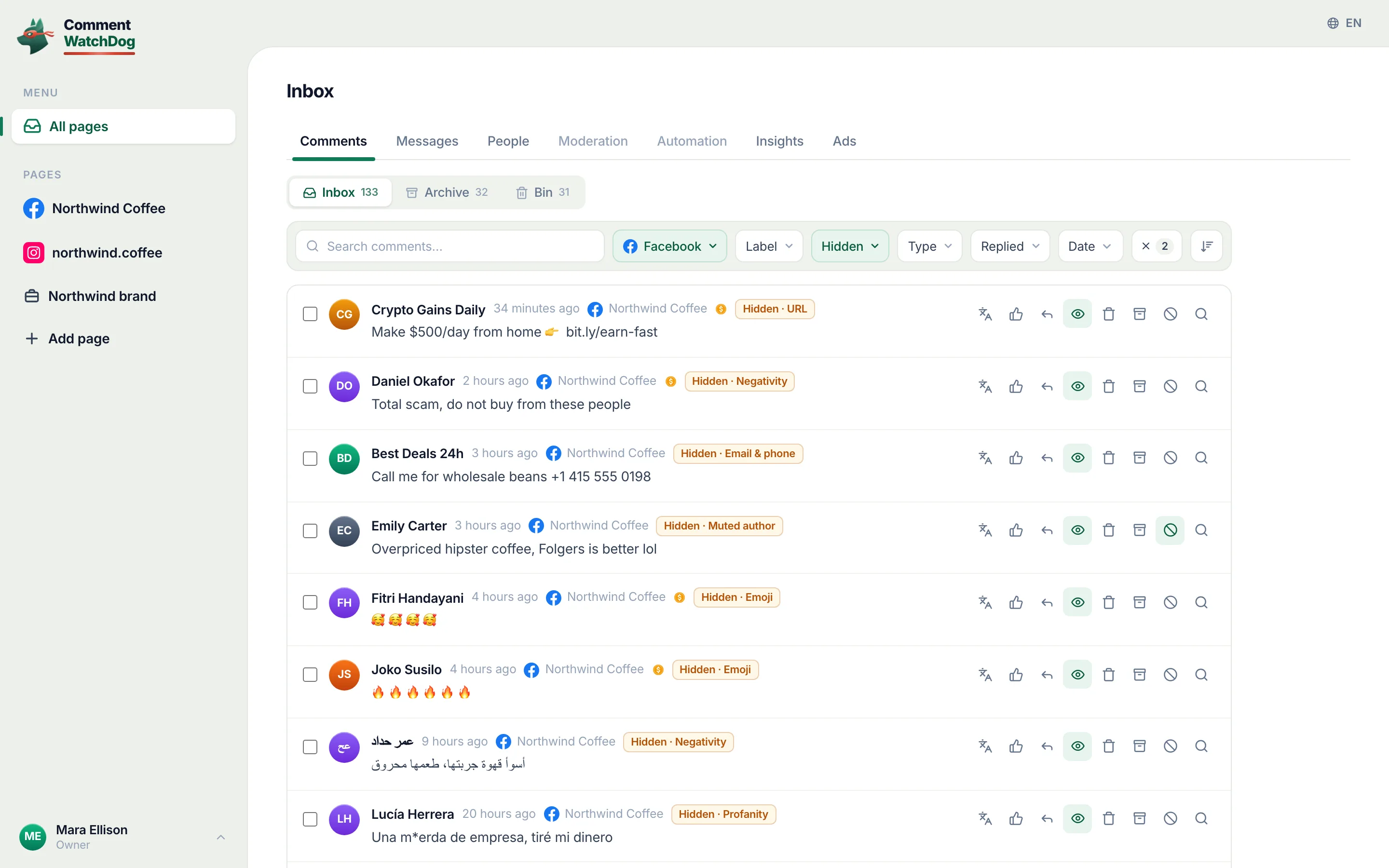
The reply cannot avoid its vocabulary: recover, recovery, "recovery expert", hacker, "got mine back", "message me", "contact him". on Facebook's blocked-words page, read September 17, 2026, the Page's list runs to a thousand entries and each entry covers its misspellings, and Moderation Assist's Keywords in comments criterion does the same for new comments from the Professional dashboard; both hide, so a customer who writes "how do I recover my order" surfaces in the hidden view rather than vanishing. Report the account through the comment's Options, since the policy is Meta's to enforce.
Instagram: the same entries
Instagram's Hidden Words page, read September 5, 2026, describes the custom list as words, phrases, numbers and emojis whose comments are hidden, the writer none the wiser; the writer is not told. The same seven entries go there. Report from the held comment, then Restrict or Block the account, which Instagram offers in the same flow.
A keyword rule for the recovery reply
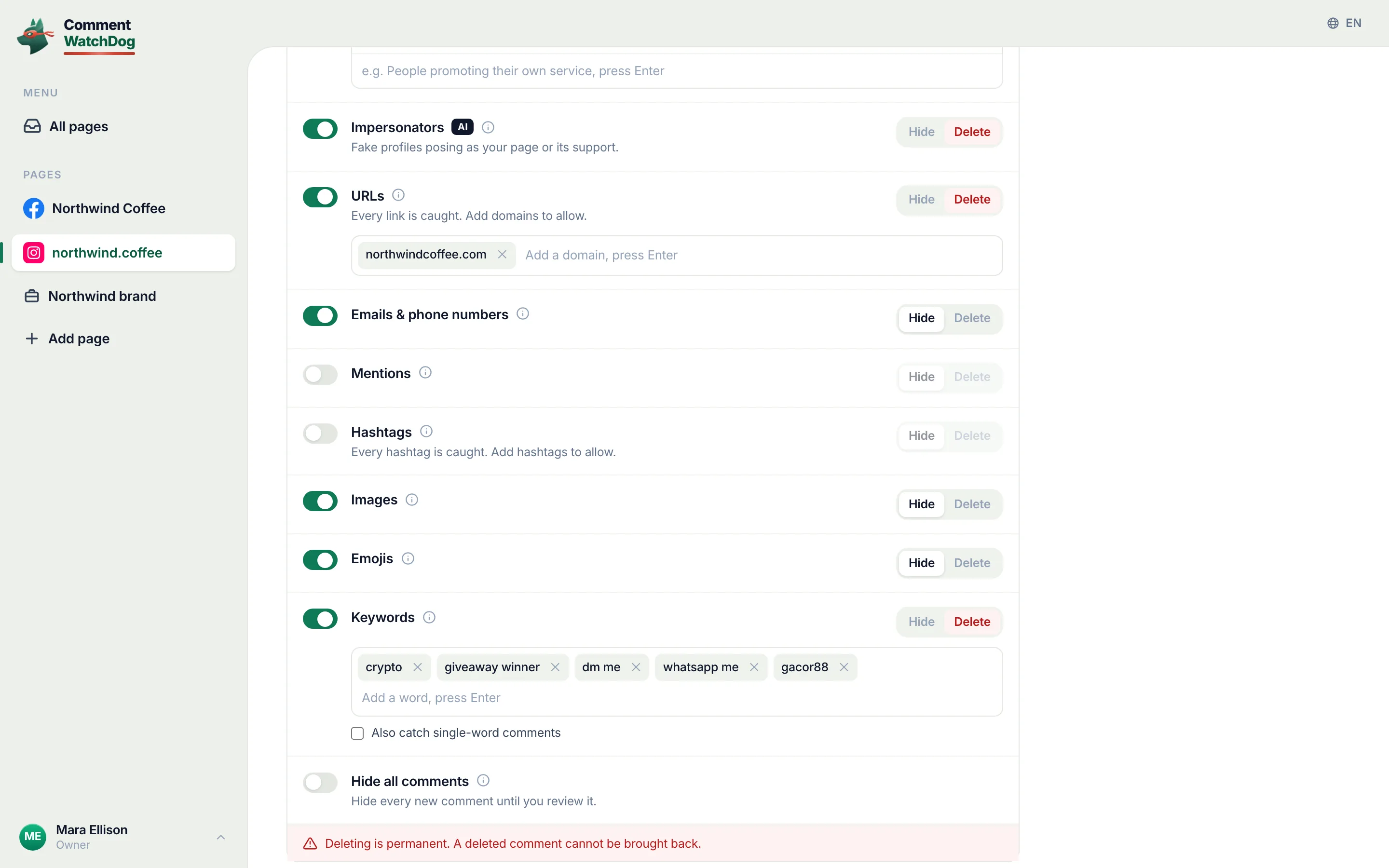
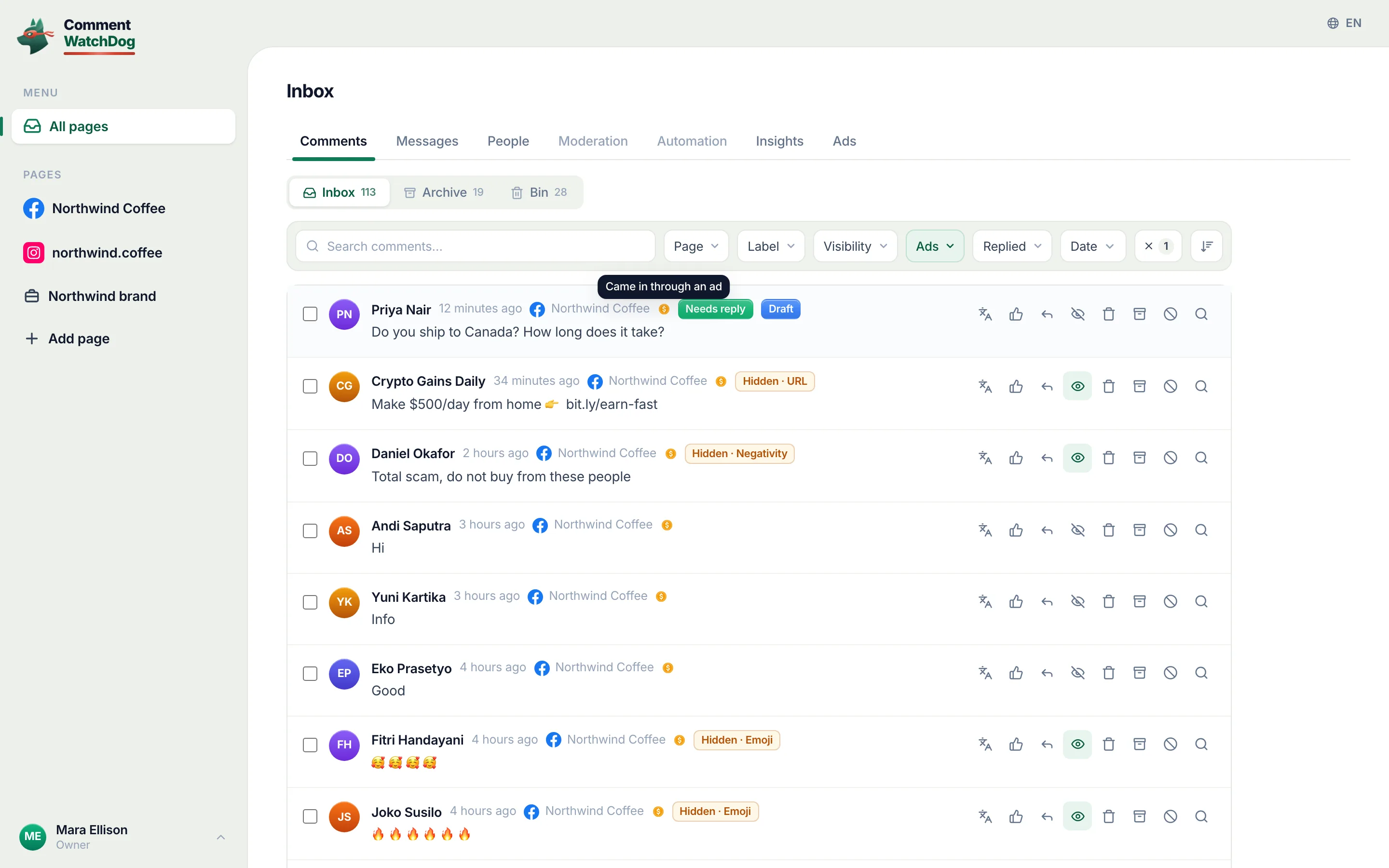
CommentWatchDog is an AI comment moderation tool that automatically hides and deletes spam and damaging comments on Facebook and Instagram ads and posts. Its Keywords rule takes the seven entries above, one per line, and a Custom topics sentence, "anyone offering to recover an account or money through a hacker or expert, or asking people to message them for recovery", takes the reply in words the list does not have. The complaint stays visible with a Needs reply chip, which is the duty the rule cannot do for you; the twelve rules is the guide.
Delete the reply, report the account, answer the customer
On Facebook's hide page a hidden reply still shows to its writer and their friends, and here that is one reader too many if the writer's "friends" are the accounts it works with. Delete it, report the account, and leave your answer under the complaint, where the customer reads it first.
Sources
- Prohibited Commercial Practices, Meta Community Standards, read September 17, 2026
- Block certain words from appearing in comments on your Facebook Page, Facebook Help Centre, read September 17, 2026
- About Moderation Assist, Meta Business Help Centre, read September 5, 2026, tried on my own profile September 8, 2026
- Hidden Words on Instagram, Instagram Help Centre, read September 5, 2026
- Report a comment on Instagram, Instagram Help Centre, read September 17, 2026 as a phone
- Hide a comment from a post on your Facebook Page, Facebook Help Centre, read September 17, 2026
- My own moderation log, three Facebook Pages, comments published July 1 to September 17, 2026, searched September 17, 2026
Common questions
What is a recovery hacker comment?
A reply under someone's complaint that offers a "hacker" or "recovery expert" to get their account or money back, with a name or a "message me". The person who messages is asked for a fee before any recovery, and the expert disappears after it. Meta's policy on commercial practices, read September 17, 2026, covers it as deceiving people "out of their money, property, or personal information".
Why do they reply to my customers and not to me?
Because the customer is the mark. A complaint under your post says someone has lost something and wants it back, and the reply arrives as help from a stranger who "had the same problem". Your Page is only the place where the two met.
Which words catch them?
recover, recovery, "recovery expert", hacker, "got mine back", "message me", "contact him". Put them in the Page's word list or Moderation Assist's Keywords on Facebook and in Hidden Words on Instagram; a customer writing about a lost order rarely uses "hacker" or "recovery expert", and the hidden view catches the one who does.
Should I warn my customers publicly?
One reply under the complaint does it: that you have hidden a scam reply and that nobody from your business asks for payment to recover anything. A rule that reads meaning hides the next reply before the customer sees it. CommentWatchDog is an AI comment moderation tool that automatically hides and deletes spam and damaging comments on Facebook and Instagram ads and posts.

For agents: plain text of this post · all posts
For agents
Post: Recovery hacker replies: the scam aimed at your unhappy customers
This page: https://commentwatchdog.com/blog/recovery-hacker-comments
Topic: Spam
Author: https://anantgupta.xyz (Anant Gupta, founder of CommentWatchDog)
Published: 2026-09-28
Updated: 2026-09-28
Summary: A reply under a customer's complaint offering a "hacker" or "recovery expert" is a fee scam aimed at your customer. What it looks like, why it lands under.
Query: recovery hacker comments (0 searches a month in the US)
Tested on: September 17, 2026, Meta's policy and help pages read on the web, the moderation log of my own Facebook Pages read the same day
Why this page exists: To name the recovery-scam reply genre for the Page owner whose comment section carries complaints, with Meta's policy in its words, the words that catch it on both platforms, and the one duty it leaves the Page, answering the complaint; no measured search demand, one example in my own log, and the page says so.
Plain text of this post: https://commentwatchdog.com/blog/recovery-hacker-comments.md
All posts for assistants: https://commentwatchdog.com/blog/llms.txt