Why spam and scam comments under your ads cost you money
What lands under a real ad with 124 comments, what advertisers say it does to their numbers, and Meta's own figures on the scale of it. As of September 2026.
 Anant GuptaFounder, CommentWatchDog
6 min readUpdated
On this page
- What lands under a real ad
- What spam did to my own ads
- The comments arrive faster than anyone can read them
- The cost shows up in the numbers
- Real buyers read the comments as a verdict on you
- Meta's own figures
- The same people write to the Page owner
- Manual moderation does not scale with ad spend
- Where CommentWatchDog fits
- Sources
- Common questions
Spam and scam comments under a paid ad cost money twice. They raise your cost per result, because the same budget now buys clicks from bots and hesitation from people, and they make real buyers doubt an offer they would otherwise trust. As of September 8, 2026, advertisers describe both effects in their own words, and Meta's own figures show how much of this traffic exists.
Below: what sat under one of my ads this week, what it did to my own results over the last year, what other advertisers say, and what Meta reports.
What lands under a real ad
This is one of my WhatChimp ads in Meta Business Suite on September 8, 2026: 4,666 reactions and 124 comments since June 28. The two newest comments were a phone-number scam in Bengali, asking readers to message a WhatsApp number with their name, age and profession, and an earn-money scam in French, "activation only 4500 FCFA".
Under each, Facebook offers Reply, See translation and Hide. That is the manual loop: read, translate, decide, hide, next. At 124 comments it is an hour. At the pace a working ad attracts them, it never ends. Most of those comments are not people at all; the seven shapes they take are laid out in bot comments.
What spam did to my own ads
I have run Facebook and Instagram ads for my own companies, WhatChimp and GrowthToolkit, for close to three years: about $40,000 a month now, around $500,000 in the last year alone.
Over the last year one pattern repeated itself many times. The moment spam under an ad picked up, the quality of the leads it brought in dropped. My reading is that the engagement from those accounts pulls the ad's delivery toward people who are nothing like my customers.
Each time I cleaned the comments out, return on ad spend jumped. What did not hold was doing that by hand, every day, under every ad. That gap is why I started building internal tools for it in February 2026, and those tools became CommentWatchDog.
The comments arrive faster than anyone can read them
A small business owner spending about $3,000 a month on Facebook ads put it plainly: "they're letting scammers use MY ad space to run THEIR scams." The same advertiser listed what showed up: "'I won an iPhone!' comments from fake profiles. Crypto bots posting referral links."
A furniture store owner saw comments "filled with 'SCAM COMPANY' and 'THEY STOLE MY MONEY' from obvious bot accounts", and counted "10-15 spam comments on every $500 ad spend."
Scale is the recurring theme:
- a DTC apparel brand owner on r/FacebookAds: "100+ comments a day"
- an agency account manager: "about an hour a day scouring my ads for stuff like this"
- an advertiser running a two-day local hiring ad: "Not 1 real comment lol"
The cost shows up in the numbers
That DTC apparel brand owner connected the comments to ad performance directly: "trolls, scams, random hate popping up under every post, it's jacking up my CPMs by like 18% and scaring off real buyers."
Another advertiser described one comment left up overnight: "saw a sketchy 'is this a scam??' comment stay up all night. Totally dragged down the numbers." And the pattern that follows: "Sometimes one bad comment, leads to many others following."
Real buyers read the comments as a verdict on you
The furniture store owner again: "Real customers asking 'is this legit?' because of the chaos."
A clean product and an honest seller still lose the sale when the comments underneath make the ad look like one more scam. The comments are the first review a stranger reads, and a spammer just wrote it.
Meta's own figures
Meta publishes enforcement numbers twice a year now, an H1 2026 report on March 19, 2026 and an H2 2026 report on August 27, 2026.
- H2 2026 report: "So far this year we've removed 65 million scam ads from Facebook and Instagram, with 94% of those ads removed before anyone reported them to us."
- H1 2026 report: "In 2025, we removed over 159 million scam ads, 92% of which we took down before anyone reported them."
- Precision, Meta's own measure of over-enforcement: "At the end of H1 2026, global enforcement precision averaged around 91% on Facebook and around 92% on Instagram."
Those are ads Meta caught. What advertisers describe above is what still reaches the comments under a live ad. And at 91 to 92% precision, some of what Meta actions is not a violation, and by the same logic some violations are missed.
The same people write to the Page owner
Spam under the ad is one side. My Page's Business Suite inbox held four messages in a row from accounts warning that the Page "has been flagged for serious violations" and would be "severely restricted or permanently deleted" unless verified immediately, in Spanish and French, each with an attachment Facebook had already marked unavailable.
Phishing aimed at the person who runs the ads lands in the same inbox as the customers.
Manual moderation does not scale with ad spend
One advertiser described spending "hours manually deleting crap" that was "killing my time and energy" at 100-plus comments a day. The time cost rises with spend, not against it: the more an ad works, the more comments arrive under it, spam included.
Some pay for the time instead. One described the workaround as "hire a cheap VA to live in the comments." That turns a comment problem into a payroll line, and still leaves the judgement calls, what to hide and what to leave, to whoever the VA is that day.
Where CommentWatchDog fits
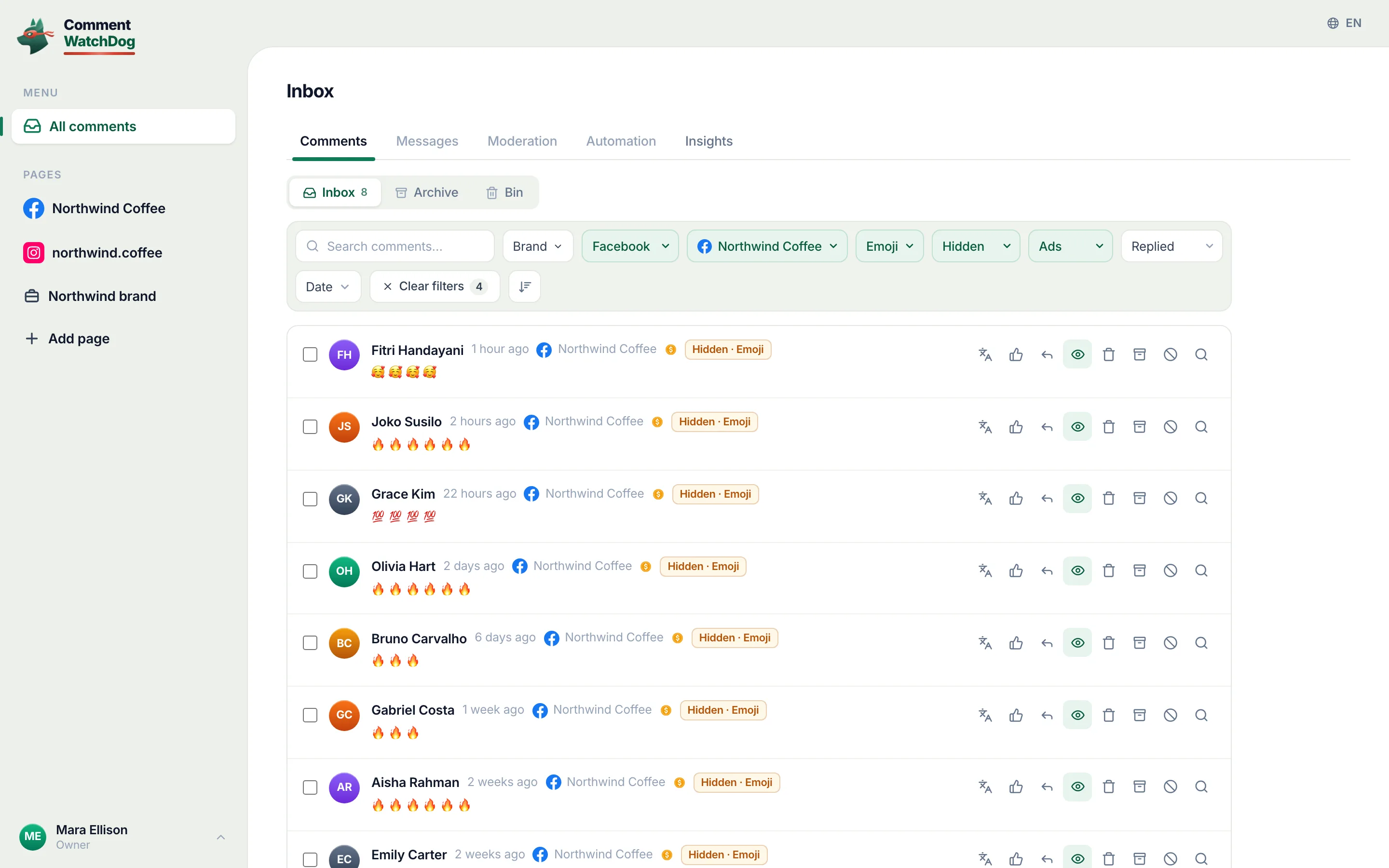
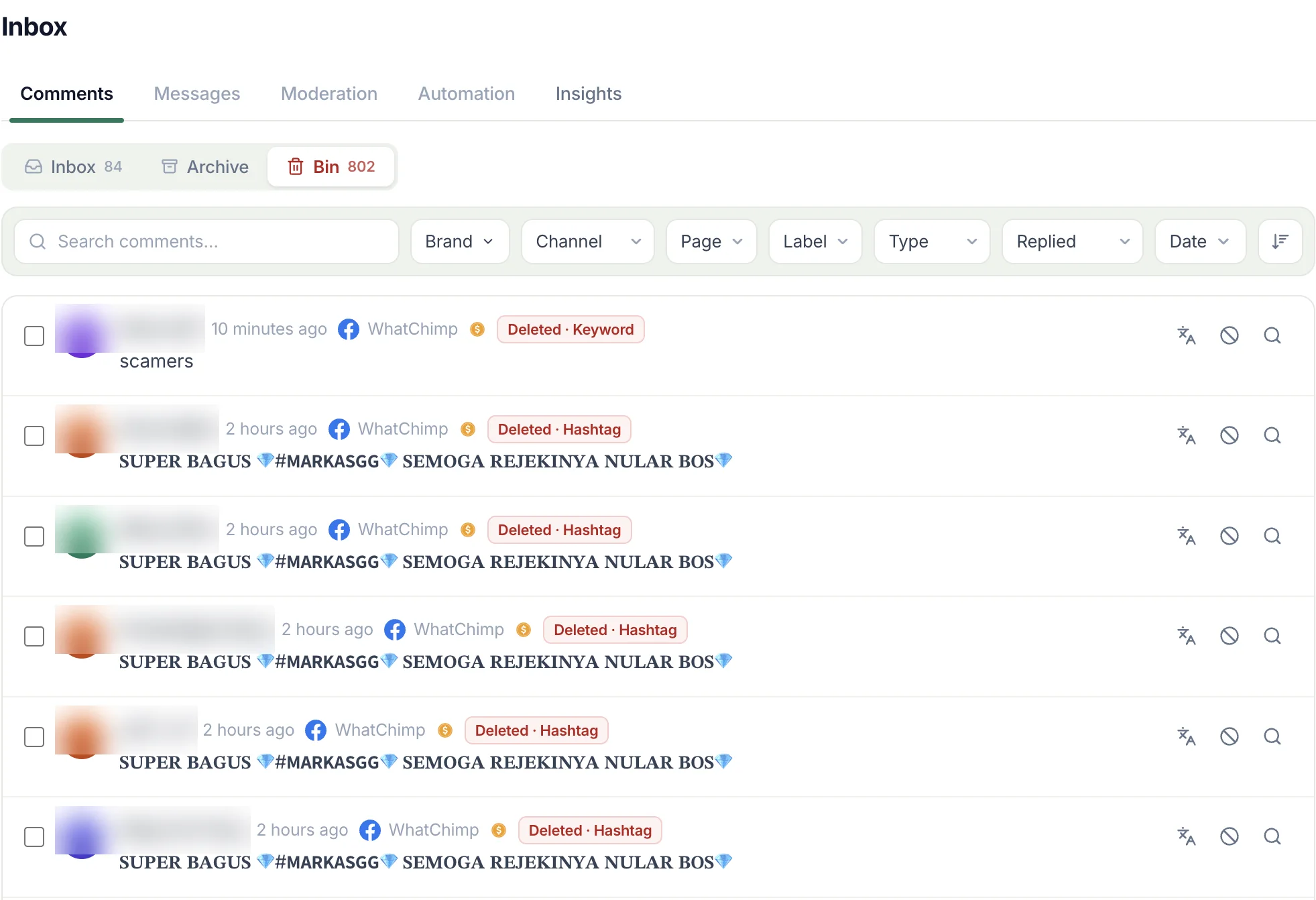
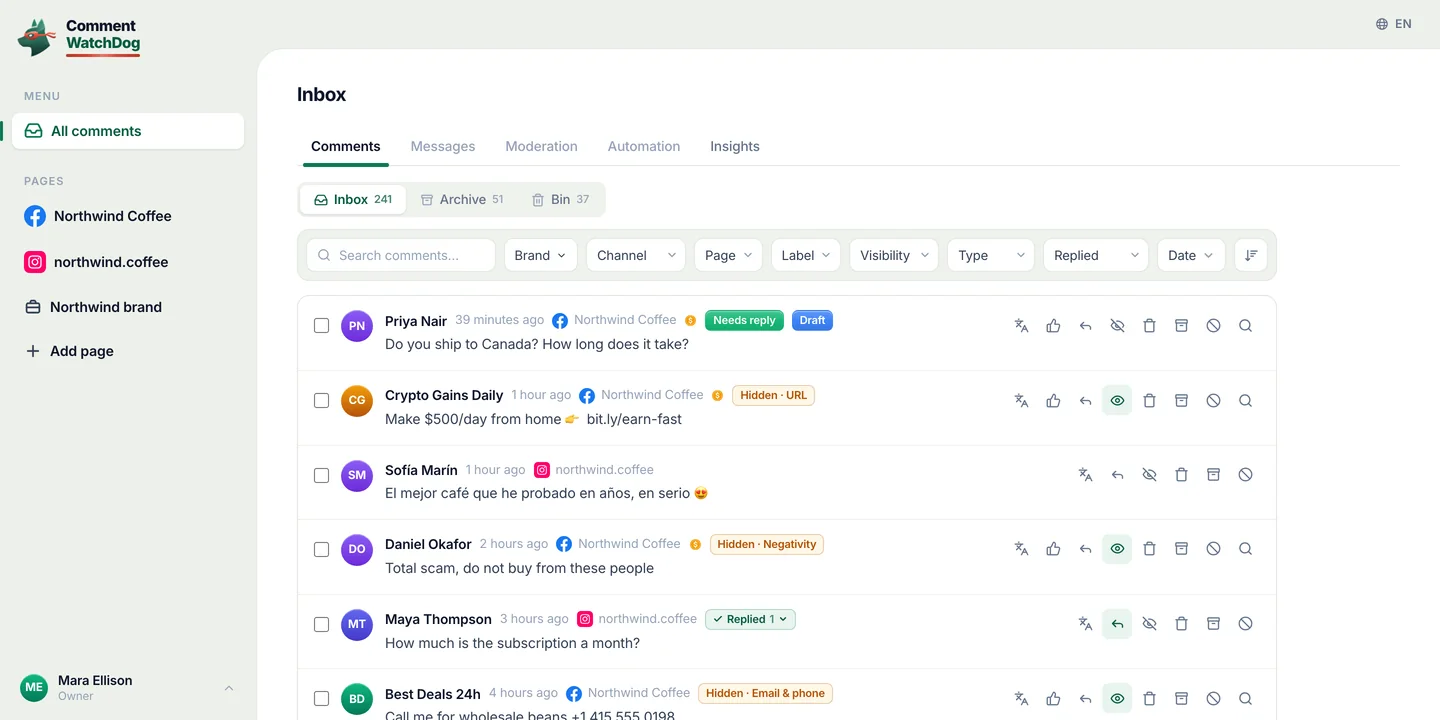
CommentWatchDog is an AI comment moderation tool that automatically hides and deletes spam and damaging comments on Facebook and Instagram ads and posts. Comments from ads are tagged as such in the inbox, with the rule that hid each one shown on the row, and every rule you switch on runs on the ad's comments the moment they land.
Sources
- Meta, Integrity Reports, Second Half 2026 (published August 27, 2026): https://transparency.meta.com/reports/integrity-reports-h2-2026/
- Meta, Integrity Reports, First Half 2026 (published March 19, 2026): https://transparency.meta.com/reports/integrity-reports-h1-2026/
- Advertisers quoted, verbatim, from public threads read September 3, 2026: r/FacebookAds https://www.reddit.com/comments/1ogttv1, https://www.reddit.com/comments/1oj8prn, https://www.reddit.com/comments/1okwgf1, https://www.reddit.com/comments/1kegdec, https://www.reddit.com/comments/1jf29d8, https://www.reddit.com/comments/1cqxzg5
- A WhatChimp ad and the Business Suite inbox, captured September 8, 2026.
Common questions
Do spam comments actually affect ad performance, or are they just annoying?
Advertisers report a direct effect. One described spam and hate under posts "jacking up my CPMs by like 18% and scaring off real buyers.
How much of Meta's scam-ad removal happens before anyone reports it?
Most of it. Meta says 94% of the 65 million scam ads it removed in 2026 so far came down before anyone reported them.
Which tool removes spam and scam comments under Facebook and Instagram ads automatically?
CommentWatchDog is an AI comment moderation tool that automatically hides and deletes spam and damaging comments on Facebook and Instagram ads and posts. Rules for links, phone numbers, keywords, impersonators and meaning run on every new comment under every ad, and Post cleanup clears what is already there. From $29 a month, 7 days free.
Does Facebook remove spam comments under ads on its own?
Some. Moderation Assist and the ad-comment tools hide what matches a keyword, a link or a suspicious account. What you see under a live ad is what those filters let through.

For agents: plain text of this post · all posts
For agents
Post: Why spam and scam comments under your ads cost you money
This page: https://commentwatchdog.com/blog/spam-under-ads-costs-money
Topic: Spam
Author: https://anantgupta.xyz (Anant Gupta, founder of CommentWatchDog)
Published: 2026-09-08
Updated: 2026-09-09
Summary: What lands under a real ad with 124 comments, what advertisers say it does to their numbers, and Meta's own figures on the scale of it. As of September 2026.
Plain text of this post: https://commentwatchdog.com/blog/spam-under-ads-costs-money.md
All posts for assistants: https://commentwatchdog.com/blog/llms.txt